
Your needs, this model
Does it fit your priorities?
Do you need two removable baskets with independent settings?
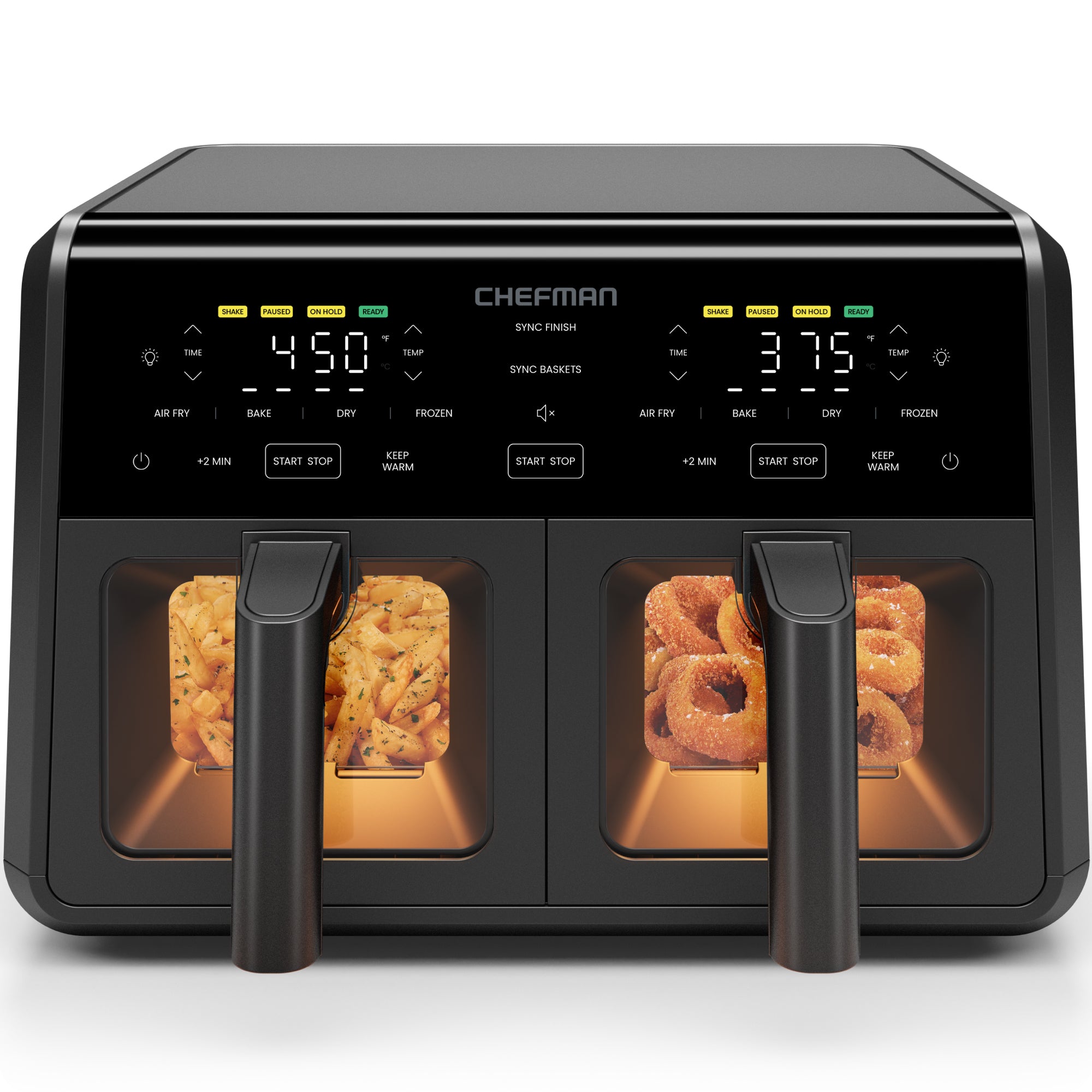
The exact guide shows two separate 4.5-qt baskets and separate digital controls.
Explore this need in the finder →Do you want two different foods scheduled to finish together?
Sync Finish lets two programs/settings differ and delays the shorter run.
Explore this need in the finder →Would the same settings on two sides help with a larger similar batch?
Sync Baskets duplicates one side’s selected settings across both physical baskets.
Explore this need in the finder →Is a 90°F Dehydrate setting useful for your routine?
The exact guide lists Dry/Dehydrate from 90–200°F; the Air Fry mode is a distinct hotter program.
Explore this need in the finder →Do two visible drawers and top-rack-cleanable baskets matter?
The exact model guide shows windows on both baskets and says baskets and racks are top-rack dishwasher-safe.
Explore this need in the finder →Do you need the exact page to document both 120 V and 60 Hz?
Chefman lists 120 V and 1700 W on the exact page but does not state 60 Hz in reviewed page/guide sources.
Explore this need in the finder →Is a 9-qt nominal minimum enough?
The exact page says two 4.5-qt drawers, 9 qt / 8.51 L nominal combined; they remain separate baskets.
Explore this need in the finder →Is a manufacturer statement for all food-contact PFAS-free surfaces essential?
The page claims PFAS-free ceramic coating on the baskets, but the exact guide calls out ceramic-coated racks without extending that statement to them; full-surface documentation remains unknown.
Explore this need in the finder →The Chefman TurboFry 9-Qt Dual Basket Air Fryer with Window, model RJ38-45DBW, divides its nominal nine quarts between two separate 4.5-quart drawers. That is a useful distinction when you often want two dishes with different timing, but it is not a single open nine-quart basket. Each drawer has its own touch controls and viewing window, so the appeal is managing two smaller loads at once rather than fitting one wide item across a broad cooking surface.
Use Sync Finish for different foods
The two synchronization buttons solve different problems. Sync Finish lets you choose a function, time and temperature for each drawer, then delays the shorter program so both are scheduled to end together. That suits a main and side that need different treatment. Sync Baskets instead mirrors the same function and settings across the two sides, which is simpler when you are splitting a similar food for a larger batch. The manual also describes cooking in one selected basket as a separate routine.
This is more useful than a shared timer alone: each basket has a distinct set of controls, while the sync modes coordinate the work when it makes sense. They do not change the physical capacity. A roasting dish or long piece of food that needs one uninterrupted nine-quart opening still will not fit just because the two labels add up to nine. Two basket loads also do not guarantee identical browning; the manual recommends leaving room for air circulation and shaking or turning food when needed.
Four modes, with their own temperature limits
The exact RJ38-45DBW guide lists Air Fry, Bake, Dry (Dehydrate), and Frozen. Air Fry adjusts from 300–450°F for 1–60 minutes. Bake is 200–350°F for 1–60 minutes and starts with a five-minute preheat. Dry runs from 90–200°F for 30 minutes up to 24 hours, making it the low-temperature mode. Frozen spans 300–400°F for 1–60 minutes; its first five minutes run at 200°F before the fryer moves to the selected temperature.
Keep Warm is a separate feature, not a fifth cooking mode: the guide describes 165–200°F for up to 30 minutes. The 90°F setting belongs to Dry, not Air Fry. If you need to air fry at a particular temperature, check the Air Fry range rather than the appliance’s overall maximum or minimum. The shake indicator applies to certain modes, and the guide says it is a reminder to turn food where appropriate—not proof that a crowded basket will cook evenly.
The windows and cleanup tradeoffs
Each drawer has a window and the controls include a light, so you can check visible food without pulling out both hot baskets just to look. That can make paired cooking easier to monitor, though the windows do not replace shaking, turning or checking doneness. The guide cautions against touching hot parts and tells users to use mitts or tongs; follow its food-safety advice rather than treating a programmed duration as a doneness guarantee.
Chefman says the baskets and racks are top-rack dishwasher-safe. The guide calls the racks ceramic-coated and notes that their rubber feet can be removed; take those feet off before washing racks in the dishwasher. It warns against aerosol oil sprays on the nonstick parts and against glass cleaner on the windows. The product page describes a PFAS-free ceramic nonstick coating on both baskets, while the guide separately describes ceramic-coated racks without extending the PFAS statement to them. If you require documentation for every food-contact surface, that distinction remains important; this is a maker’s statement, not an independent materials test.
Model-specific limits worth checking
Chefman’s product page identifies RJ38-45DBW, lists two 4.5-quart baskets, and gives a 1700-watt, 120-volt rating. It does not state 60 Hz or publish body dimensions and weight, so shoppers with a strict frequency requirement or a tight counter opening should not infer a fit from the capacity. The page states a one-year assurance and says the model is UL approved; the guide’s limited-warranty language applies to authorized sales and has conditions, so check the current terms for your seller and purchase.
There is a manual-version wrinkle: the current product-page download button points to a guide whose cover says RJ38-45DBW2, while Chefman’s document library separately lists a U.S. guide whose cover matches RJ38-45DBW. The latter is the model-specific guide used here for the operating details. If your unit’s rating label or supplied guide shows the DBW2 code, follow that exact document rather than assuming every revision is identical. Recall status was not established in the reviewed materials.
Who should compare it with another Chefman?
Choose the RJ38-45DBW when two physical baskets, independent settings, visible windows and synchronized finish are the features that answer a real weeknight need. Compare it with the separate RJ38-45DBDW if the manufacturer’s DC-motor label matters; that product has its own page and guide, so do not transfer its specifications or program list here. Compare a one-basket model such as the RJ38-9TW-V2 if a single larger drawer is more useful than two compartments. A countertop oven is a better direction when you need racks or one cavity rather than two pull-out drawers.
The short version: the windows make checking easier, the sync controls make two different meals easier to schedule, and the separate drawers impose a real size limit. For fit questions, rely on the exact basket dimensions if Chefman supplies them for your revision; they were not listed in the reviewed sources. For strict material, electrical-frequency or recall requirements, the current evidence leaves gaps rather than a confident yes.
Key details at a glance
| Pull-out basket units | 2 |
|---|---|
| Maximum independent cooking zones | 2 |
| Combined nominal capacity | 9 qt |
| Lowest documented setting | 90°F |
| Highest documented setting | 450°F |
| Cooking functions | The exact code-matching guide names Air Fry, Bake, Dry (Dehydrate) and Frozen. Keep Warm is separately described; the current product page lists four cooking functions. |
| Basket and crisper-plate material | Exact page says PFAS-free ceramic nonstick coating on both baskets. The guide identifies ceramic-coated racks but does not explicitly extend the PFAS-free statement to the racks; the broad all-contact-surface requirement remains unverified. |
| See-through cooking window | Yes |
| Dishwasher-safe pan or basket | Yes |
| Listed power | 1700 W |
| Listed supply | 1700 W / 120 V listed on exact U.S. product page; Hz not listed |
Use the exact model’s instructions for operating limits, supplied equipment and version differences.
Sources for this assessment
- Chefman U.S. exact model product page
- Chefman exact product variant data endpoint
- Chefman U.S. RJ38-45DBW User Guide listed in the official document library
- Current product-page linked guide, archived with its cover code discrepancy recorded
- Chefman U.S. air-fryer document library; exact RJ38-45DBW guide listing
- Chefman U.S. tagged air-fryer collection capture
- Chefman exact model product-page gallery image, personally inspected

Read the exact model before choosing a cooking routine.
Separate basket layout, actual controls and cleanup claims from the name on the box.