
Your needs, this model
Does it fit your priorities?
Would a 90°F Dry/Dehydrate setting help with low-temperature batches?
The RJ38-7TW-Series guide lists Dry (Dehydrate) from 90–200°F; Air Fry starts at 300°F, so the low setting belongs only to the drying program.
Explore this need in the finder →Do you prefer a single windowed basket over two independently controlled drawers?
This configuration has one pull-out basket and one cooking zone. The window helps check progress but cannot prepare two dishes on separate settings.
Explore this need in the finder →Is a 450°F Air Fry or Broil ceiling sufficient?
The manual lists Air Fry at 300–450°F and Broil at 425–450°F; other programs top out lower.
Explore this need in the finder →Is 7 qt nominal capacity enough, without treating it as a servings guarantee?
Chefman states a nominal 7 qt / 6.62 L; the label does not establish a load weight or usable-volume promise.
Explore this need in the finder →Must the basket and rack be top-rack dishwasher safe?
The model-series guide says both are top-rack dishwasher safe once cool; the housing must be wiped, not submerged or washed in a dishwasher.
Explore this need in the finder →Do you need an explicit PFAS-free statement or remote-control cooking?
The maker documents a nonstick surface but no coating chemistry or full-surface PFAS-free statement; the guide says the appliance is not for external timers or remote control.
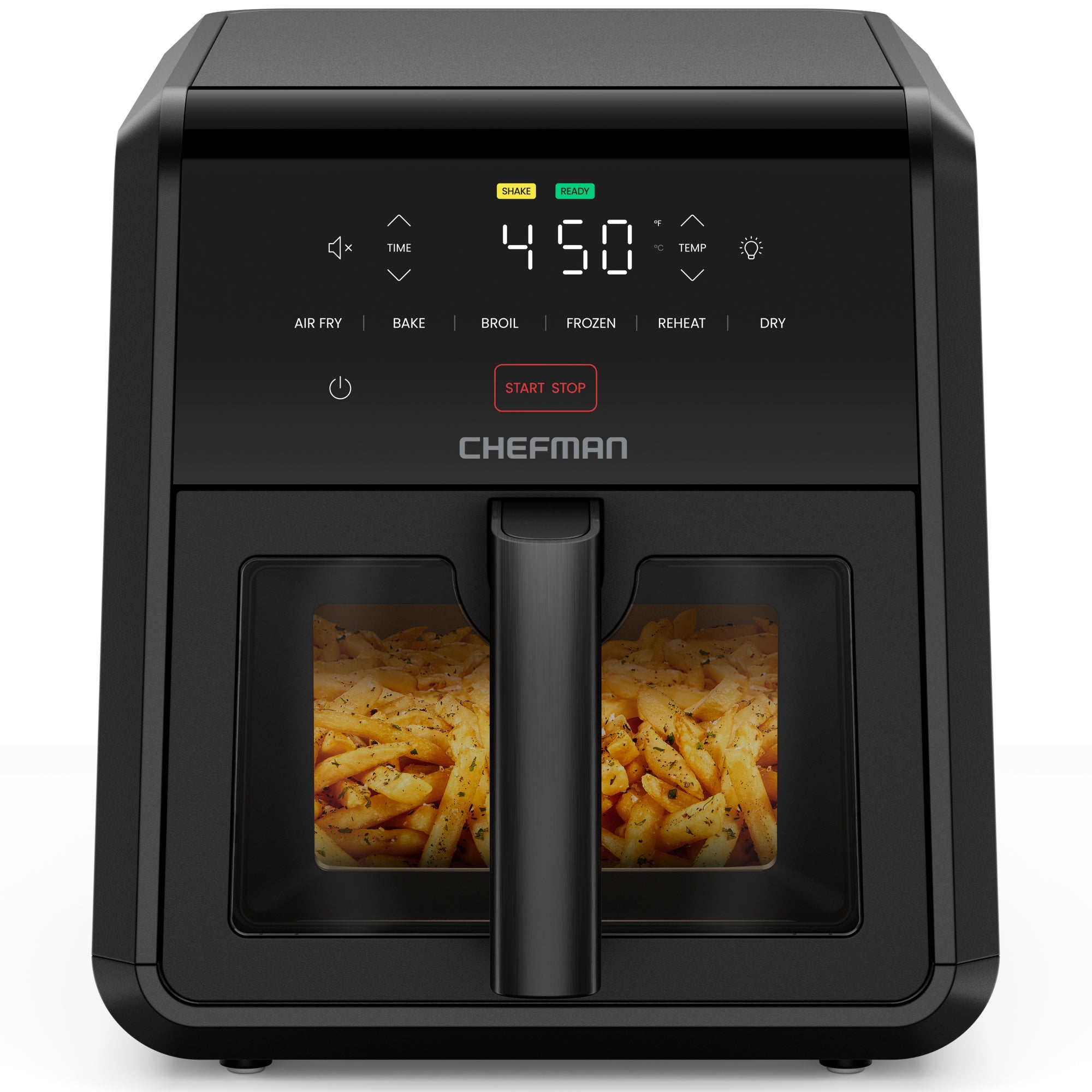
Explore this need in the finder →The Chefman TurboFry 7-Quart Digital Air Fryer is a one-drawer countertop model, not a dual-basket machine. Its exact U.S. listing identifies model RJ38-7TW and a matte-black finish; the associated 20-page guide is for the RJ38-7TW series, and Chefman’s document library has a distinct U.S. guide entry for this model, separate from the -CA version. The manufacturer page showed the U.S. listing out of stock when checked. That status can change, so verify the exact model and seller configuration before shopping.
One long drawer, one program at a time
The maker lists 7 quarts (6.62 liters) of nominal basket capacity. That may suit a household that wants a single large batch rather than splitting dinner across two drawers, but nominal volume is not a load limit or a measured promise that a particular tray of food fits. Chefman describes the profile as narrow and elongated and says it can accommodate long foods such as salmon or asparagus. Check your own food and counter dimensions: the listed appliance dimensions are 17.36 × 11 × 10 inches, but the specification does not label which number is width, depth or height. The manual’s practical space instruction is clearer: leave at least six inches above and behind the fryer.
Inside, there is one removable basket and one rack. Air Fry, Bake, Broil, Frozen, Reheat and Dry/Dehydrate are six different selectable programs, not six independent cooking chambers. If you need two foods to cook at different temperatures simultaneously, a two-zone model is the better direction. The window and panel light make it easier to inspect browning without opening the drawer, but neither feature shakes food for you; the guide’s reminder is a prompt to shake or turn when appropriate.
Read the individual temperature ranges
The headline 90–450°F span does not describe every program. The RJ38-7TW-Series manual lists Air Fry from 300–450°F, Bake from 200–400°F, Broil from 425–450°F, Frozen from 300–400°F, Reheat from 300–425°F and Dry (Dehydrate) from 90–200°F. Those distinctions matter if a questionnaire asks for a low dehydration setting or a high broiling ceiling: use the relevant mode, not a range copied from another button. For Frozen, the guide says the first five minutes run at 200°F before the appliance increases to the selected setting. Its default program times are starting values; the guide does not state an ordinary maximum cycle timer.
The panel has separate time and temperature buttons and a light button. Chefman says the unit has a DC motor and advertises “up to 40% faster” cooking. That remains a maker claim rather than a comparative test result. The guide permits an optional five-minute preheat but does not require one. It also says the appliance is not intended for an external timer or separate remote-control system. Choose it for local operation, not phone-based monitoring or remote starts.
Cleaning and material questions
Chefman describes the basket as nonstick and the guide says both basket and rack are top-rack dishwasher safe after they cool. The housing is wiped clean and must not be immersed or put in the dishwasher. The manual also warns against aerosol cooking spray on nonstick parts because it can chip the coating. Neither the exact U.S. product page nor the guide identifies the coating chemistry or says that every food-contact surface is PFAS-free. If an affirmative full-surface material statement is essential, this listing does not establish it; an unknown coating should not pass that filter.
Space and power details to verify
Weight is listed as 10.7 pounds. Chefman consistently gives 120 volts, but its own page conflicts on wattage: descriptive copy says 1750 W while the Specifications block says 1700 W. I would not turn that conflict into a firm circuit-planning number. Check the unit’s rating label or ask Chefman before purchase if the exact load matters. The page says cETL approved; this review records the manufacturer’s statement, not an independent certification check. The guide gives a limited one-year warranty for qualifying authorized-retailer purchases and calls for proof of purchase.
Who should compare something else?
Consider the RJ38-7TW if a windowed, single-basket routine and low-temperature drying are more useful than synchronized cooking. If more nominal room matters but one drawer is still acceptable, compare Chefman’s listed 9-quart single-basket models and check their exact code-specific ranges rather than assuming the 7-quart guide applies. If two dishes need different settings or synchronized finish, choose a model with documented independent zones; a higher preset count cannot substitute for that feature. If coating chemistry, exact wattage, a numerical cycle-time limit or verified 60-Hz documentation is a hard requirement, the available RJ38-7TW page and series guide leave that question unanswered.
Primary sources: exact RJ38-7TW U.S. product page; RJ38-7TW-Series U.S. user guide; Chefman Air Fryer Document Library.
Key details at a glance
| Pull-out basket units | 1 |
|---|---|
| Maximum independent cooking zones | 1 |
| Combined nominal capacity | 7 qt |
| Connected app controls | No |
| Lowest documented setting | 90°F |
| Highest documented setting | 450°F |
| Cooking functions | The U.S. guide charts six separately selectable modes. Frozen starts at 200°F for its first five minutes before rising to the selected setting. The guide gives default times, not a maximum cycle timer. |
| Basket and crisper-plate material | Basket/rack described as nonstick; exact product page and manual do not identify the coating chemistry or make a complete-surface PFAS-free statement. |
| See-through cooking window | Yes |
| Dishwasher-safe pan or basket | Yes |
| Listed supply | The page consistently lists 120 V but conflicts on power: 1750 W in descriptive copy vs 1700 W in the Specifications block. Check the physical rating label or ask Chefman before relying on a wattage figure. |
Use the exact model’s instructions for operating limits, supplied equipment and version differences.
Sources for this assessment
- Chefman TurboFry 7-Quart Digital Air Fryer, exact RJ38-7TW U.S. product page
- Chefman Shopify payload for exact U.S. listing
- Chefman air-fryer U.S. document library: RJ38-7TW User Guides
- Chefman RJ38-7TW-Series U.S. User Guide, 20 pages
- Chefman U.S. collection parsed row at position 18 (reused existing archive)
- Chefman exact RJ38-7TW manufacturer gallery image 1

Read the exact model before choosing a cooking routine.
Separate basket layout, actual controls and cleanup claims from the name on the box.