
Your needs, this model
Does it fit your priorities?
Would one 8-qt nominal basket and one cooking zone fit your normal batch?
The exact RJ38-8T-BLACK page and matching RJ38-8T-Series guide describe a single pull-out basket; it cannot split into independently controlled cooking zones.
Explore this need in the finder →Do you need a named Dry/dehydrate function that reaches 90°F?
The guide's Dry program spans 90–200°F. That lower setting is specific to Dry rather than Air Fry.
Explore this need in the finder →Is a 450°F full-cycle air-fry setting essential, rather than a two-minute finish boost?
Regular Air Fry is listed at 300–400°F. HI-FRY reaches 450°F for two minutes at the end of eligible cycles; it does not document a full 450°F cycle.
Explore this need in the finder →Would a top-rack dishwasher-safe basket and rack matter?
The exact guide confirms top-rack dishwasher cleaning for the removable basket and rack; the housing is not dishwasher-safe.
Explore this need in the finder →Do you require an explicit manufacturer statement about PFAS-free food-contact surfaces?
The reviewed product page and guide do not make that exact-model statement, so this requirement is not confirmed.
Explore this need in the finder →This exact Chefman is an opaque, single-drawer digital air fryer with four programmed functions and a special two-minute high-heat finish. Its advertised “High Fry” should not be confused with a normal 450°F air-fry cycle.
What this exact model is
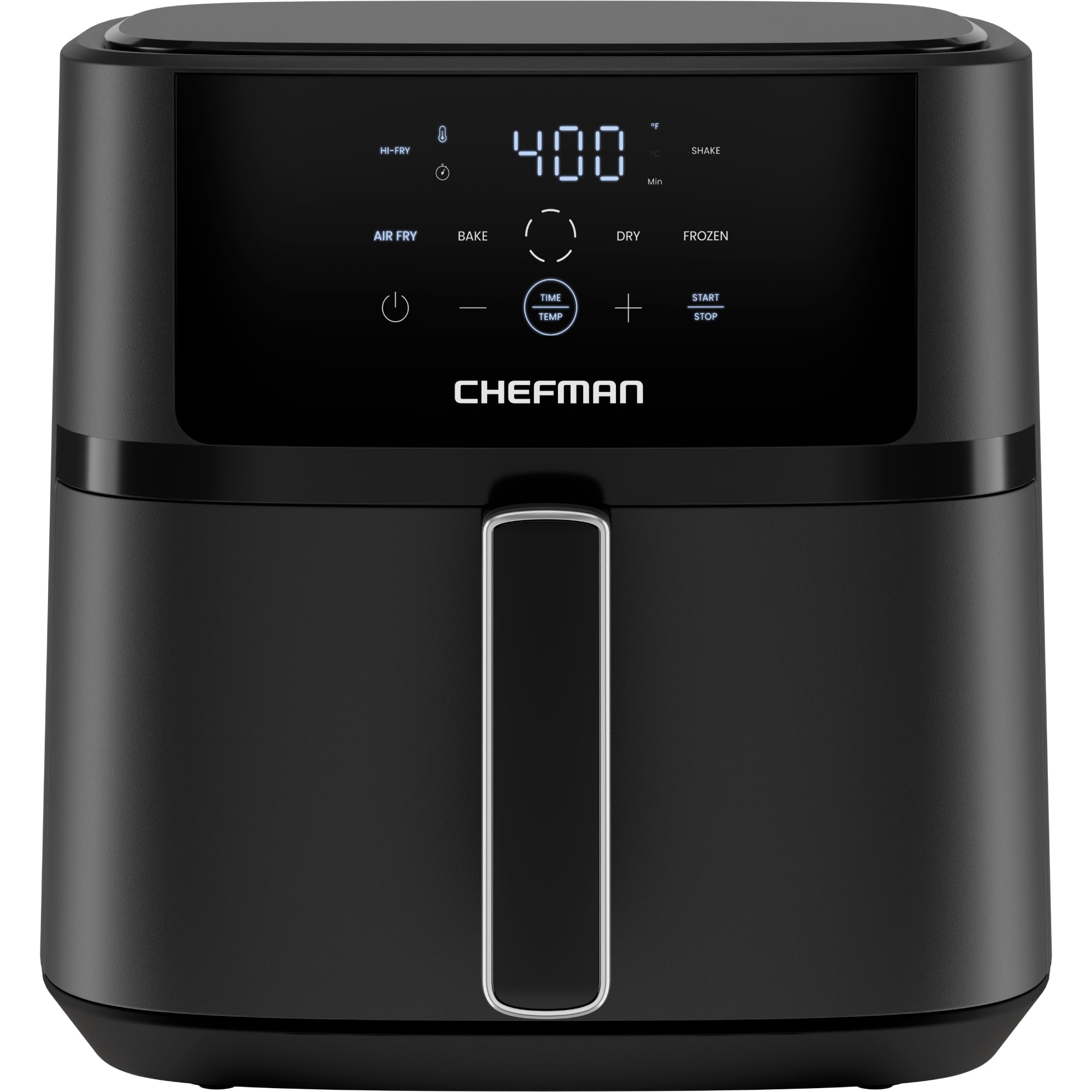
The U.S. Chefman product page identifies the black configuration as model RJ38-8T-BLACK. Its 20-page, model-family-matched RJ38-8T-Series guide describes an eight-quart digital air fryer. The controls and removable cooking space are the straightforward pull-out-basket layout: one basket, one cooking zone, and no separately scheduled second side. The exact gallery image shows a solid, opaque drawer front rather than a viewing window. The collection page includes several other TurboFry products, so don’t substitute details from a similarly sized windowed or dual-basket model when checking a seller’s listing.
Four programs, with different jobs
The manual gives Air Fry a 300–400°F range, Bake 200–350°F, Dry 90–200°F, and Frozen 300–400°F. Those are separate programs, not one temperature span that every setting can use. In particular, the 90°F low end belongs to Dry; it does not turn this into a low-temperature air-fry appliance. Dry’s table default is six hours, but the guide does not establish that as a maximum timer setting. The other displayed defaults are 15 minutes for Air Fry, 30 for Bake, and 30 for Frozen; they are starting values, not evidence that a mode cannot be adjusted farther.
The Frozen program starts with five minutes at 200°F as part of its cooking cycle, then moves to the selected setting. Food goes into the basket before starting; it is not an empty preheat. Bake handles its preheat differently: the guide says the unit displays “PRE” for its first five minutes before the timer begins. If you mainly air-fry packaged frozen food, that distinction helps avoid treating a thawing stage as an extra preheat step.
What “High Fry” actually adds
HI-FRY raises the temperature to 450°F for the final two minutes of a cook cycle that lasts at least five minutes. It is not available in Dry. That makes it a brief browning finish, not a selectable full-duration 450°F Air Fry range. If your requirement is simply to have a short hotter finish, this is a documented feature; if you need a regular cycle to hold 450°F, this model’s normal Air Fry range stops at 400°F. The manufacturer’s product name alone doesn’t answer that distinction.
Capacity and daily handling
Eight quarts is a nominal capacity, not a promise about the volume you can use while leaving space around the food, or a guaranteed number of portions. The basket’s removable rack creates space for air to circulate and lets excess fat drain below the food. The manual warns against packing the basket past its MAX line and recommends smaller, looser loads when even browning matters. Its shake reminder appears with selected programs; the guide says to shake or turn as appropriate and check food for doneness rather than rely only on the timer.
Because the front is opaque, checking progress means pulling out the basket. The manual says cooking pauses when the drawer is removed and resumes when it is returned. That small routine may be entirely fine if you already shake food halfway through; it is a poor match if you specifically want to monitor browning through a window without opening the drawer. The exact sources I checked do not list dimensions or weight, so measure your available counter space and drawer-removal path rather than assuming an eight-quart unit will fit beneath a cabinet. Chefman calls for a flat, heat-resistant surface and at least six inches of clearance above and behind the fryer.
Cleaning and material limits
The guide says the basket and rack are top-rack dishwasher-safe after they have cooled. It also cautions against aerosol cooking spray on the nonstick parts, which can damage the coating, and says not to immerse or put the appliance body in the dishwasher. Use a non-abrasive cleaning approach and let the unit cool before handling or removing the rack. The exact page and guide do not identify the basket substrate, coating chemistry, or PFAS status. A shopper who requires an explicit PFAS-free statement should treat that information as unknown, not assume it from the brand or from the term “nonstick.”
Who should choose it—and who should look elsewhere?
This Chefman suits someone who wants one roomy nominal basket, uncomplicated digital time-and-temperature controls, a dedicated Dry function, and the option of a short hot finish. It is less compelling if your routine depends on cooking two foods at different settings at once. The RJ38-45DBDW is the more relevant Chefman alternative for that need because its exact guide describes two independently controlled 4.5-quart drawers with synchronized-finish options. If you want to check food without opening the drawer, the separate RJ38-9TW-V2 has a window and light, but it is a different model with different operating programs.
For the RJ38-8T-BLACK, the product page and guide I reviewed do not provide a numerical voltage, frequency, wattage, ordinary-mode timer maximum, or exact-model recall determination. They also do not settle coating chemistry. Do not use this assessment to satisfy a strict electrical, long-timer, surface-chemistry, or recall-clearance requirement. The guide describes a one-year limited warranty and sets conditions around authorized sales and proof of purchase; retain the receipt and consult current terms for a particular claim.
Key details at a glance
| Pull-out basket units | 1 |
|---|---|
| Maximum independent cooking zones | 1 |
| Combined nominal capacity | 8 qt |
| Lowest documented setting | 90°F |
| Highest documented setting | 400°F |
| Cooking functions | The exact guide names four cook functions. Their defaults are not interpreted as time limits. HI-FRY is a brief special finish, not a fifth cooking function or a full-cycle 450°F Air Fry range. |
| Basket and crisper-plate material | The guide warns against aerosol spray on nonstick parts but does not identify basket substrate, coating chemistry or PFAS status. |
| See-through cooking window | No |
| Dishwasher-safe pan or basket | Yes |
Use the exact model’s instructions for operating limits, supplied equipment and version differences.
Sources for this assessment

Read the exact model before choosing a cooking routine.
Separate basket layout, actual controls and cleanup claims from the name on the box.