
Your needs, this model
Does it fit your priorities?
Do you want the food basket itself to be glass, rather than a clear window over another basket material?
AFC-4's manual identifies its removable cooking vessel as borosilicate glass; a separate ceramic-coated crisper plate sits inside it.
Explore this need in the finder →Is one small, 4-quart cooking zone enough, or do you require two separate baskets?
The AFC-4 has one 4-qt pull-out glass vessel. It does not split into independently controlled zones.
Explore this need in the finder →Would a 4-quart nominal-capacity threshold fit, or is at least 5 qt essential?
The exact AFC-4 is labeled 4 qt; the actual single-layer area and listed food examples are still more informative than capacity alone.
Explore this need in the finder →Would a cooking window let you monitor the food without opening the drawer?
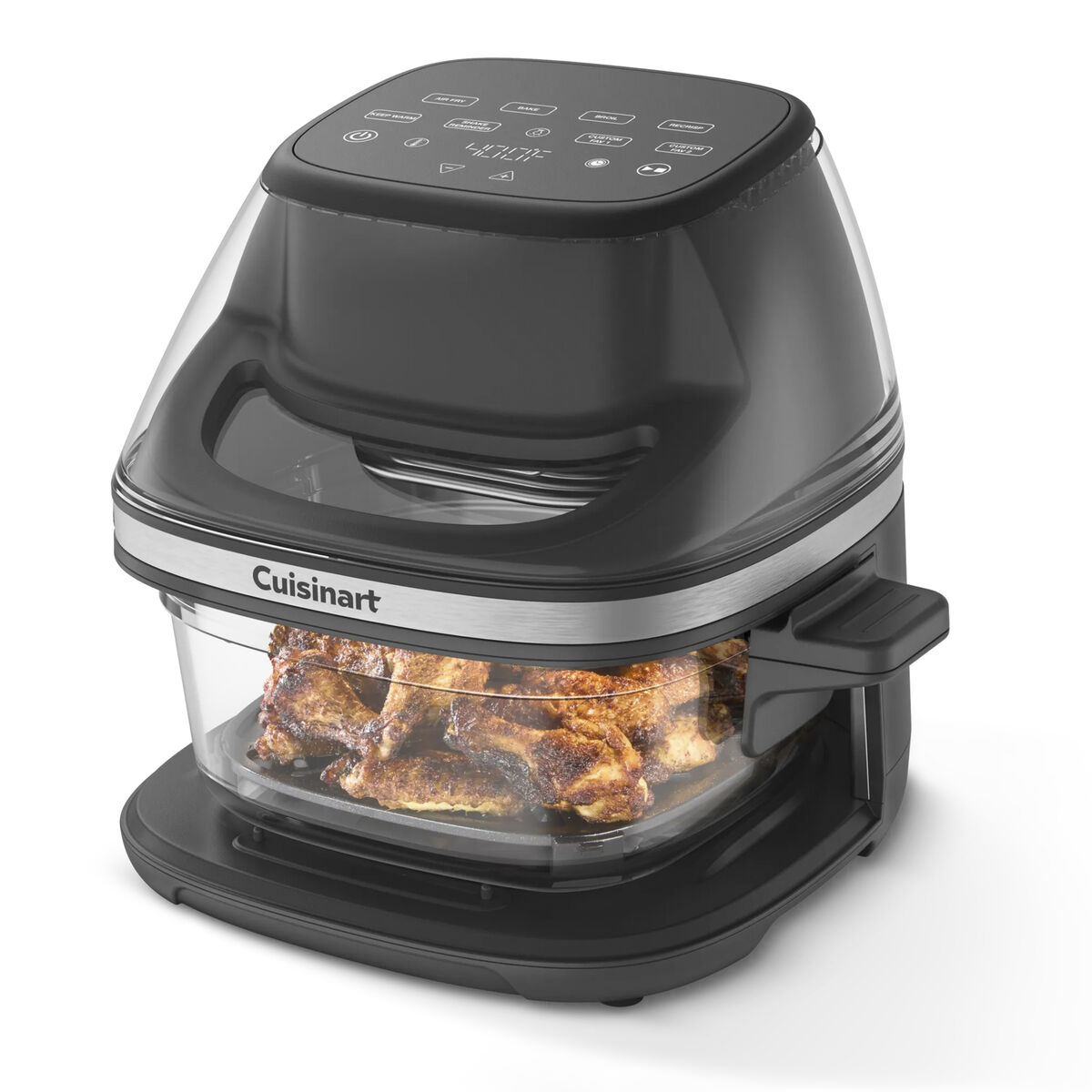
The glass basket and top window plus interior light allow a view into the cooking vessel, according to the exact page and booklet.
Explore this need in the finder →Is dishwasher cleaning of the removable cooking basket an essential condition?
The exact booklet says the glass bowl, storage lid and crisper plate are dishwasher-safe; it still requires cooling and careful glass temperature handling.
Explore this need in the finder →The Cuisinart ClearView AFC-4 is a single-zone, 4-quart air fryer whose removable cooking basket is clear borosilicate glass. That is more than a viewing window: the vessel itself is designed to move from preparation into cooking, then to the table, and into the refrigerator after it has cooled. A separate crisper plate sits inside the glass basket during cooking. Choose the AFC-4 if you value that transparent, serve-and-store routine and your usual portions fit a 7.75-inch square surface. Its 4-quart label is not a substitute for checking how much food needs to sit in one layer.
A glass vessel, not a bigger meal by itself
Cuisinart identifies the basket as borosilicate glass and describes its 7.75-by-7.75-inch base as a single-layer crisping area. The included crisper plate is a different component: it has a ceramic nonstick surface and silicone feet, and the manual says it must be inserted during cooking. Cuisinart lists the plate as PFAS-free; that statement is specific to the plate rather than a general claim about every part touching food. If you are trying to avoid a particular coating, read the exact material statement rather than treating “glass basket” as a description of the plate.
The instruction booklet offers practical, model-specific portion examples: up to a pound of fries, a pound and a half of wings, four salmon fillets, or a whole chicken up to four pounds when using Bake without the crisper plate. It also recommends a single layer and says overlapping food can cook unevenly. These are maker examples, not a measured batch test or a promise that every shape fills the bowl equally well. For a larger family batch or room to spread food broadly, compare the 9-quart AFC-9: its stated cooking area is 10.8 inches square. If two different foods must cook simultaneously at separate settings, look at a two-zone product such as Cuisinart’s ADZ dual-basket pair instead; the AFC-4 has one basket and one program at a time.
Five modes and a visible cook
The AFC-4 offers Air Fry, Recrisp, Bake, Broil and Keep Warm, with a digital touchscreen, two saved Custom Favorite settings, shake reminder and interior light. Its maximum is 450°F, adjustable in five-degree increments. The minimum temperature and maximum timer setting are not stated in the product material reviewed, so do not select it for a hard requirement on either. The glass basket and top window let you check browning without pulling out the vessel. Automatic pause when the basket is removed is useful for turning food, and the manual says Keep Warm can continue for up to an hour after cooking unless the basket stays out too long or the unit is turned off. It is still a standard one-zone appliance, not a way to prepare a main and side at different temperatures in parallel.
The viewing arrangement may reduce how often you need to interrupt cooking, but it does not remove the manual’s advice to flip or shake when the food needs it. The manufacturer charts still call for turning foods such as fries and wings. Think of the window as visibility, not automatic doneness sensing.
Glass changes cleanup and temperature handling
The basket, lid and crisper plate are listed as dishwasher-safe. The basket can also serve for cooled leftovers, but the manual says to wait until the glass is fully cool before fitting its storage lid. It describes the vessel as freezer-safe and thermal-shock resistant, while also warning against sudden temperature changes; if the basket comes from the freezer, let it stand at room temperature for at least 15 minutes before heating. That instruction makes this storage feature a less casual transfer than moving a room-temperature plastic tub straight to heat. Avoid metal tools that could damage the crisper plate’s surface, unplug and cool the fryer before washing, and do not immerse its housing.
Counter placement deserves attention. The booklet asks for two to four inches of clearance around the appliance, says not to use it on heat-sensitive surfaces, beneath wall cabinets or in an appliance garage, and warns that the exterior gets hot. It also says not to leave the unit unattended during operation. The maker lists 1,600 watts and the manual’s warranty language specifies 120-volt outlets; neither source states a 60-Hz rating. The precise external dimensions and basket weight were not provided in the reviewed exact-model material, so measure the actual space and plan how you will handle the glass vessel rather than guessing from the quart rating.
Who should choose AFC-4?
Choose this ClearView if a visible glass food basket, a cooled-basket storage step and a modest single-layer portion area match your routine. It is less compelling if the first priority is capacity, two separate cooking zones, a published low-temperature setting or a documented 120 V / 60 Hz supply. The AFC-9 keeps the one-basket format but increases the stated area and portions; the ADZ-110 or ADZ-112 Pro provide two independently set baskets instead of one transparent vessel. Confirm the AFC-4 model code, and use the instructions supplied for that exact model. Cuisinart’s product page lists a three-year limited household warranty; that does not establish expected service life or durability.
Sources: Cuisinart AFC-4 product page and AFC-4 instruction booklet.
Key details at a glance
| Pull-out basket units | 1 |
|---|---|
| Maximum independent cooking zones | 1 |
| Combined nominal capacity | 4 qt |
| Highest documented setting | 450°F |
| Cooking functions | Five modes named in the exact AFC-4 page and manual. The manual also documents two custom favorite slots and an optional shake reminder; custom favorites are not additional cooking modes. |
| Basket and crisper-plate material | The exact manufacturer page/manual explicitly describe the ceramic-coated crisper plate as PFAS-free, but do not give a blanket PFAS-free statement for every food-contact surface. The glass vessel and plate are different parts. |
| Exact configuration note | Exact U.S. AFC-4; a single pull-out vessel is borosilicate glass. Do not conflate the separate AFC-4BPL accessory-set row with the fryer itself. |
| See-through cooking window | Yes |
| Dishwasher-safe pan or basket | Yes |
| Listed power | 1600 W |
| Listed supply | Grounded 120 V outlet (manual warranty clause); frequency not stated |
Use the exact model’s instructions for operating limits, supplied equipment and version differences.
Sources for this assessment
Read the exact model before choosing a cooking routine.
Separate basket layout, actual controls and cleanup claims from the name on the box.