
Your needs, this model
Does it fit your priorities?
Do you want to see browning without pulling the drawer?
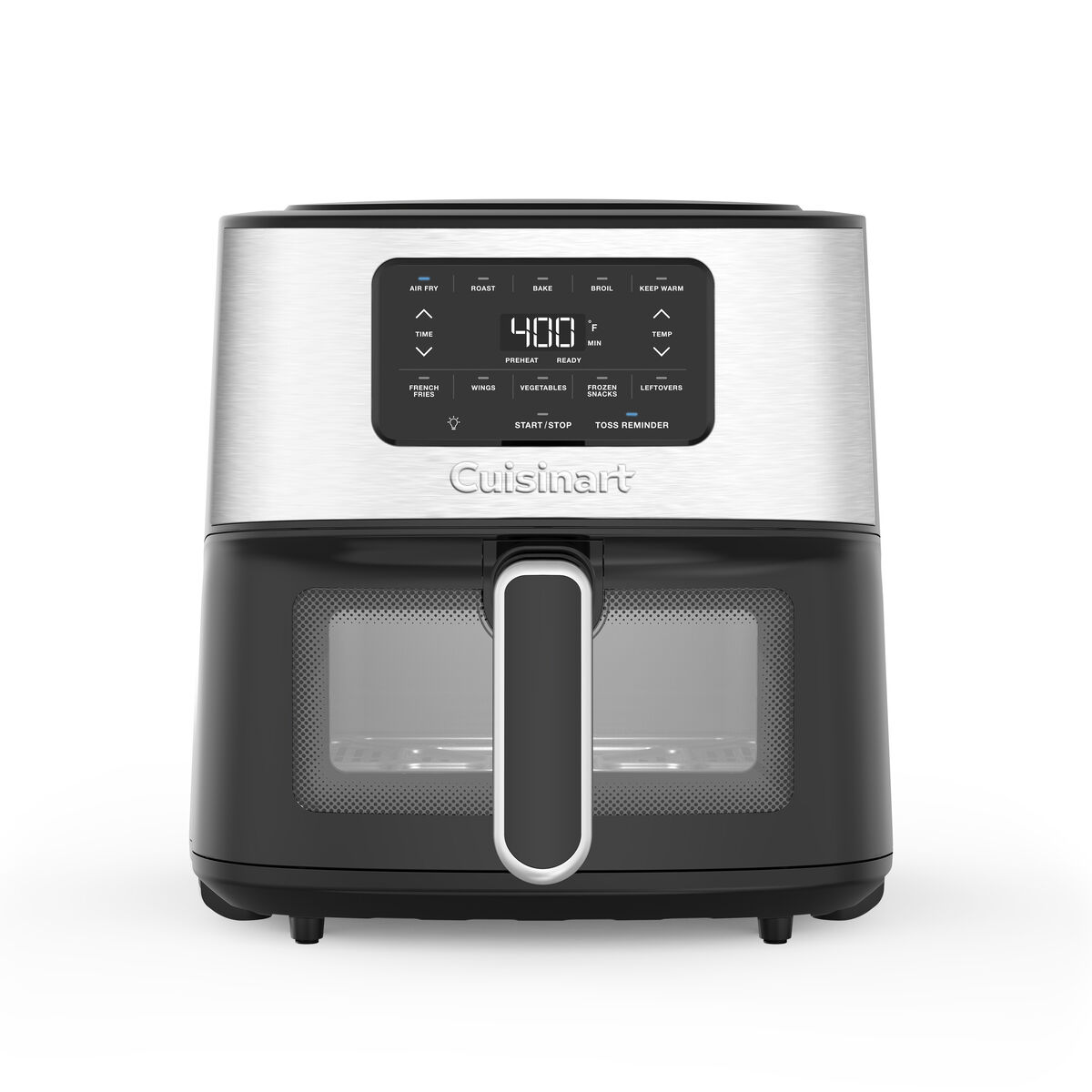
AIR-200NAS has a viewing window and interior light; opening the drawer still pauses the cycle and turning food may still be needed.
Explore this need in the finder →Is a documented Broil mode important alongside air frying?
The exact AIR-200NAS page and linked booklet list Broil; the AIR-210 manual does not list Broil.
Explore this need in the finder →Would a six-quart basket be enough, or is eight quarts essential?
AIR-200NAS is labeled six quarts; its manual examples and 9-inch-square cooking surface help set more realistic portions than the volume number alone.
Explore this need in the finder →Is dishwasher cleaning of the removable cooking parts essential?
The exact AIR-200NAS booklet permits dishwasher cleaning of its basket and crisper plate.
Explore this need in the finder →Would you require a confirmed glass or stainless-steel basket body?
The AIR-200NAS page identifies ceramic nonstick wording but not its basket substrate; an unknown substrate cannot meet a glass or stainless body requirement.
Explore this need in the finder →The Cuisinart AIR-200NAS is a single-drawer, six-quart basket fryer aimed at cooks who want a fairly broad square cooking surface, a window for checking browning and oven-like modes without moving to a countertop oven. Its 9-by-9-inch cooking surface and one-zone layout are the practical facts to weigh against the larger, elongated AIR-210: a bigger nominal capacity does not create a second timer or let dinner and a side cook independently.
One square basket, with a useful view
Cuisinart specifies six quarts and the linked instruction booklet gives the removable basket a nine-inch-square cooking surface. The manual's example chart includes four five-ounce salmon fillets, two pounds of shrimp, and a whole chicken up to four pounds. Those are maker recipe quantities, not results from independent testing, and they do not promise that every food will brown evenly when stacked. Cuisinart's own guidance says to avoid overloading, use minimal overlap, and toss or flip foods when appropriate. If your normal meal depends on a broad single layer, that surface dimension is more informative than the quart label alone.
A front window and interior light let you monitor color without removing the drawer. Pulling the basket out pauses cooking; this is convenient for a mid-cook check, but it does not remove the need to turn foods or verify doneness. There is still only one removable basket and one cooking zone. You cannot use a different time or temperature for a side while the main dish runs. If divided timing is the essential requirement, the Cuisinart ADZ-110 or ADZ-112 Pro represents a different arrangement; if you need more one-layer area rather than two zones, the AIR-210's manual lists a longer 8.5-by-12-inch surface.
Five modes, five presets, and a small documentation wrinkle
The AIR-200NAS page lists Air Fry, Roast, Bake, Broil and Keep Warm, plus five one-touch air-fry presets for fries, wings, vegetables, frozen snacks and leftovers. These presets are shortcuts within air frying, not five additional cooking modes. The manual also gives a toss reminder, a viewing light, a timer up to 60 minutes, and an automatic Keep Warm period of up to an hour. Its maximum is 450°F; the exact materials reviewed do not establish the lowest available temperature or the temperature step.
There is a small but useful difference between the page summary and the operating booklet: the product page says the five functions need no preheat, while the linked booklet describes preheat steps for Bake and Broil. The manual is more detailed for setup, so treat baking and broiling as modes with a preheat workflow rather than assuming every cycle begins cold. The touchscreen allows manual time and temperature changes, and the five presets add convenience when they match what you cook. They do not sense food size or replace checking the food.
Dishwashing and surface claims
The page describes a PFAS-free ceramic nonstick crisper basket and identifies a separate crisper plate in the package; the footnote says no intentionally added PFAS. The manual says the basket and plate can go in a dishwasher. The manufacturer does not identify the underlying basket substrate or explicitly extend the PFAS statement to every food-contact part, so this is not a match for a strict glass- or stainless-steel-body requirement, nor should the narrow coating statement be turned into a broader chemical guarantee. The manual calls for cooling, unplugging and nonabrasive cleaning, and says the removable plate should be lifted out to reach residue at the bottom of the basket.
Counter planning and what remains unknown
The listed exterior dimensions are 12 by 16.5 by 12.25; the listing shows a weight of 14.5 without a unit, so neither the basket's lift weight nor a pound rating should be guessed. The page states 1,800 watts and the linked manual warranty text limits use to 120-volt outlets. The materials do not document 60 Hz, which matters if you require both voltage and frequency to be printed for an exact-model electrical filter. The three-year limited household warranty is a term of coverage, not evidence of expected service life.
Set it on a level, heat-safe surface with two to four inches around it. The booklet warns that the exterior gets hot and says not to operate beneath wall cabinets or inside an appliance garage. That clearance requirement can matter as much as the six-quart capacity in a tight kitchen.
Who is it for?
Consider the AIR-200NAS if your meals fit a single medium-size basket, you want to watch browning through a window, and you value Broil and Bake alongside Air Fry. Look elsewhere if you need a second independent zone, a clearly documented low temperature, proven 60-Hz labeling, a specific basket substrate, or a 9-quart capacity. The AIR-210 trades the square windowed basket for more nominal volume and an elongated surface; the 9-quart AFC-9 offers a wider one-zone basket and additional windows, while the ClearView AFC-4 changes to a true glass cooking vessel but less capacity. Those choices change the actual cooking plan, not simply the model name.
For a side-by-side look at the six- and eight-quart tradeoffs, read the AIR-200NAS versus AIR-210 comparison.
Sources: Cuisinart AIR-200NAS product page and the instruction and recipe booklet linked from that page.
Key details at a glance
| Pull-out basket units | 1 |
|---|---|
| Maximum independent cooking zones | 1 |
| Combined nominal capacity | 6 qt |
| Highest documented setting | 450°F |
| Cooking functions | Exact page lists Air Fry, Roast, Bake, Broil and Keep Warm; five presets are shortcuts, not separate operating functions. Page copy says no preheat is needed, while the linked manual describes a Bake and Broil preheat workflow. |
| Basket and crisper-plate material | Cuisinart calls its ceramic nonstick crisper basket PFAS-free and footnotes “no intentionally added PFAS.” The page does not identify the underlying basket substrate or expressly detail every contact component; treat a strict all-surfaces disclosure as unresolved. |
| Exact configuration note | Exact U.S. model AIR-200NAS; do not transfer capacity, controls, materials, window, or accessory claims from another Cuisinart configuration. |
| See-through cooking window | Yes |
| Dishwasher-safe pan or basket | Yes |
| Listed power | 1800 W |
| Listed supply | 120 V outlets stated in the linked manual warranty clause; line frequency is not stated |
Use the exact model’s instructions for operating limits, supplied equipment and version differences.
Sources for this assessment
Read the exact model before choosing a cooking routine.
Separate basket layout, actual controls and cleanup claims from the name on the box.