
Your needs, this model
Does it fit your priorities?
Would you rather load an oven through a door than use a pull-out drawer?
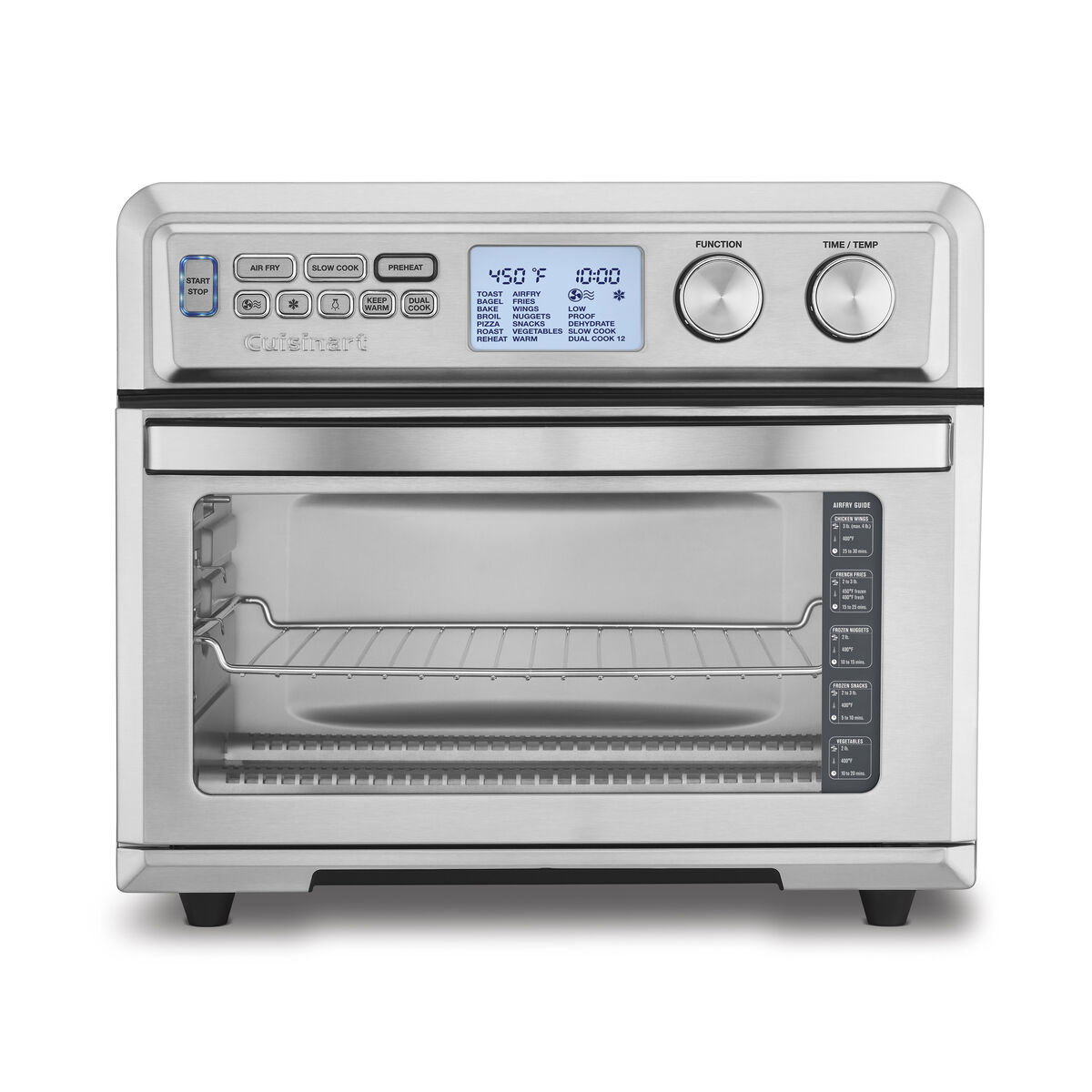
The TOA-95NAS has one door-front countertop oven cavity. Its air-fry basket is an accessory placed inside the cavity, not a drawer fryer.
Explore this need in the finder →Do you need the oven to proof dough at a documented low temperature?
The booklet linked from the exact product page lists Proof from 80°F to 100°F, up to two hours; this is still one oven cavity.
Explore this need in the finder →Is a dedicated dehydrating mode useful, or do you need a separate grill program?
The linked booklet documents Dehydrate from 100°F to 200°F, up to 72 hours. Cuisinart's exact product materials do not name Grill.
Explore this need in the finder →Does dishwasher cleaning of the air-fry basket need to be confirmed?
The linked booklet permits dishwasher cleaning of the air-fry basket and baking/drip pan; it directs hand washing for the oven rack and crumb tray.
Explore this need in the finder →Do you need two foods cooking at separate temperatures at the same time?
No: Dual Cook runs a pair of cooking stages consecutively in the same cavity. It does not provide two independent zones.
Explore this need in the finder →Is a documented quart rating a hard capacity requirement?
Cuisinart lists a 0.95-cubic-foot cavity and food/pan fit examples, not nominal air-fryer basket quarts. A quart minimum should not be inferred from cubic feet.
Explore this need in the finder →The Cuisinart TOA-95NAS is a countertop oven with an air-fry basket, not a pull-out drawer fryer. Its appeal is range: the same door-front cavity can handle toast, bake, broil, roast, pizza and air-frying, while its linked instruction booklet also describes proofing, dehydration, low-temperature cooking and a two-stage program. If you want an oven that can air-fry, those are useful capabilities; if you want two dishes cooked at different settings at once, the format is wrong.
One oven cavity, even when the program name says Dual Cook
Cuisinart lists a 0.95-cubic-foot cavity and supplies an oven rack, baking pan, air-fry basket and crumb tray. The basket sits inside the oven; it is not a separate drawer or a second cooking zone. The booklet’s Dual Cook feature lets you program two stages that run one after the other—for example, a hotter browning stage followed by a lower-temperature stage. It is not simultaneous cooking. A dual-basket air fryer is a better fit when separate foods need independent time and temperature settings.
For capacity, use the maker’s real fit examples rather than converting oven volume into basket quarts. Cuisinart says the oven can fit a 9-by-13-inch pan, a 13-inch pizza or nine slices of toast, and lists Air Fry capacity up to four pounds. These are manufacturer examples, not independent tests of how evenly a full load browns. A deep pan, handles or rim can make a nominal 9-by-13-inch dish larger than its cooking surface, so compare the outside dimensions of your own cookware.
Air frying is one setting among several oven jobs
The booklet gives Air Fry a 200–450°F range and a timer of up to one hour. It names five presets—fries, wings, nuggets, snacks and vegetables—and says the fan stays on High for those presets. Manual time and temperature changes are still possible. Cuisinart recommends placing the basket in the baking/drip pan, using the middle rack position for air-frying and checking large or overlapping loads partway through. That routine matters more here than the large-load headline: piling food above the basket’s intended layer can reduce exposure to the circulating air, and the maker itself suggests tossing or turning food when needed.
The oven also has a window and light, which let you inspect browning without opening the door. The manual’s air-fry chart gives examples such as wings, fries, frozen appetizers and vegetables, but actual results depend on food size, load and how often you check. Treat those charts as starting points, not a guarantee that one preset will cook every brand or cut exactly the same way.
More low-temperature work than a basic basket fryer
The linked booklet documents a 100–200°F Dehydrate range for up to 72 hours, a Proof range of 80–100°F for up to two hours, and a Low mode from 100–300°F for up to 12 hours. Slow Cook has High and Low settings; the book suggests using a covered ovenproof dish with liquid when you want results closer to a conventional slow cooker. The product page’s short feature list does not mention Proof, but the booklet linked from that exact page does. The extra programs therefore add real one-cavity flexibility, not separate cooking spaces.
Temperature and time limits vary by function. Bake, Roast and Reheat have their own ranges; Toast and Bagel use shade and slice selections instead of a user-set temperature. Bake and Pizza use a preheat stage, and the oven has a separate Preheat button. The manufacturer gives a 450°F maximum, but do not assume every program uses the same settings or timer limit.
Measure the counter and plan the cleanup
The listed exterior dimensions are 13.125 inches long, 17.875 wide and 15.625 high. The instruction booklet calls for leaving two to four inches between the oven and nearby walls or objects, warns that the exterior gets very hot, and says not to operate it under cabinets or in an appliance garage. That clearance can be more important than the footprint itself on a crowded counter. Cuisinart lists 1,800 watts and a three-year limited U.S. household warranty; the warranty is a stated term, not evidence of expected lifespan.
Cleanup is mixed rather than all dishwasher-safe. The booklet allows the air-fry basket and baking/drip pan in the dishwasher. The oven rack and crumb tray need hand washing, and the crumb tray must be in place during use. Cuisinart identifies a stainless-steel interior, stainless-steel pan and basket and says “No intentionally added PFAS.” That wording does not identify a basket coating or prove that every food-contact surface is PFAS-free, so a strict coating or material requirement needs more specific disclosure.
Who should compare something else?
Choose the TOA-95NAS when you will use the oven-format jobs, the included basket and pan, or the low-temperature programs, and you can give a large oven the required clearance. Choose a drawer model if you want the basket to pull out to shake food, a stated quart rating, or a compact form. Choose a documented dual-zone design if two foods must cook independently at once. The TOA-95NAS combines several modes in one machine, but it cannot make those operating needs coexist simultaneously.
Sources: Cuisinart TOA-95NAS U.S. product page and its linked instruction and recipe booklet. The manufacturer does not identify whether the gallery image is a photograph or CGI.
Key details at a glance
| Pull-out basket units | 0 |
|---|---|
| Maximum independent cooking zones | 1 |
| Connected app controls | No |
| Lowest documented setting | 80°F |
| Highest documented setting | 450°F |
| Cooking functions | The exact product page lists Air Fry, Bake, Broil, Pizza, Roast, Dual Cooking, Reheat, Keep Warm, Toast, Bagel, Dehydrate, Low and Slow Cook. Its linked booklet also documents Proof and a Preheat button. Dual Cook is sequential, not another cavity or simultaneous zone. |
| Basket and crisper-plate material | The exact product page says stainless-steel interior, stainless-steel baking pan and air-fry basket, and 'No intentionally added PFAS.' It does not identify a basket coating or claim every food-contact surface is PFAS-free; do not upgrade the limited statement. |
| See-through cooking window | No |
| Dishwasher-safe pan or basket | Yes |
| Listed power | 1800 W |
| Listed supply | The linked U.S. booklet says the appliance is designed only for 120-volt outlets; it does not state 60 Hz. |
Use the exact model’s instructions for operating limits, supplied equipment and version differences.
Sources for this assessment
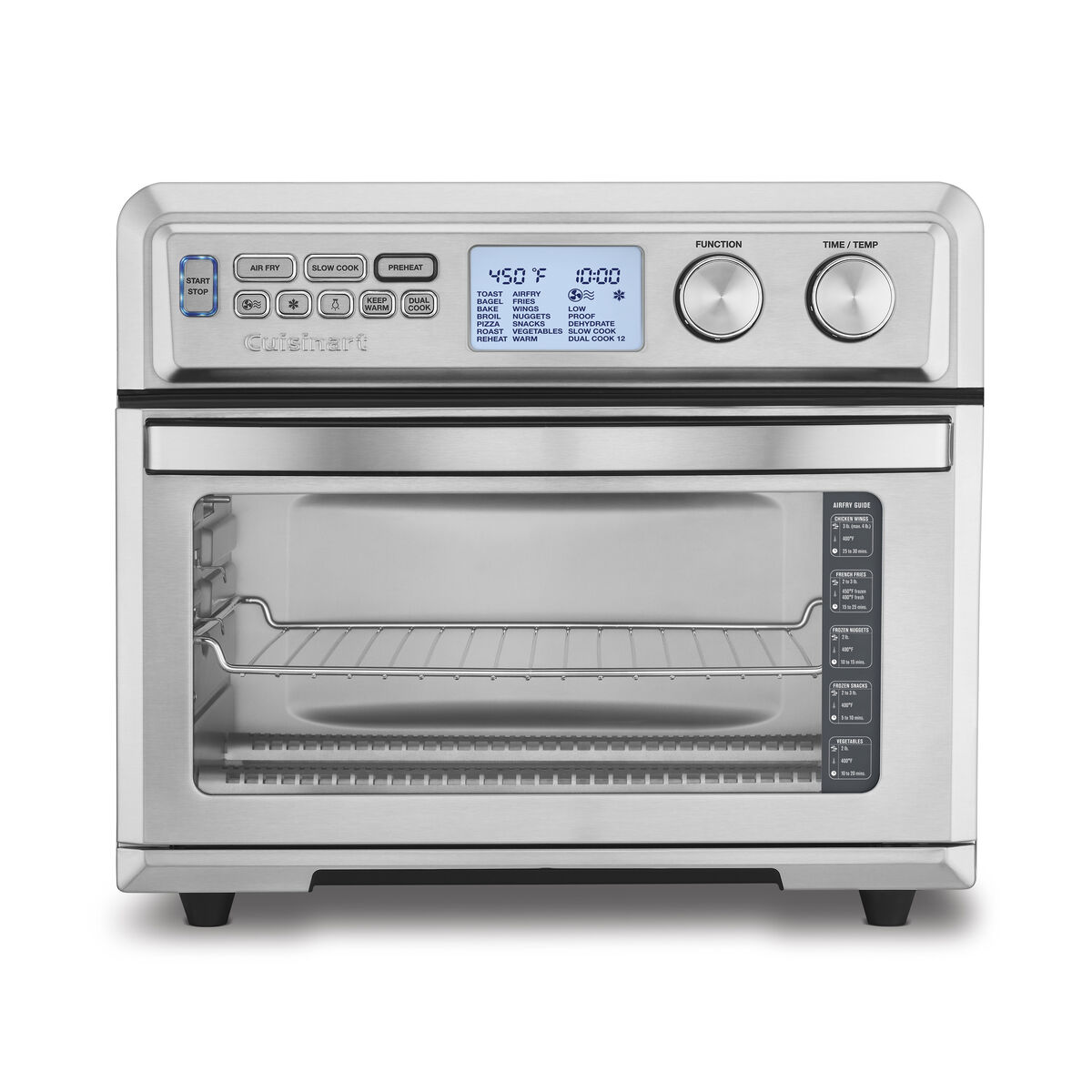
Read the exact model before choosing a cooking routine.
Separate basket layout, actual controls and cleanup claims from the name on the box.