
Your needs, this model
Does it fit your priorities?
Are you identifying an existing Philips appliance by the full code on its label?
This exact discontinued support/product identity is NA110/00R0, not the separately listed NA110/00 U.S. configuration.
Explore this need in the finder →Does the appliance need to match ordinary 120 V / 60 Hz household supply?
Yes. Philips's exact R0 technical table says 220–240 V / 50–60 Hz, so it does not meet a required 120 V / 60 Hz condition.
Explore this need in the finder →Do you need a documented low-temperature drying mode rather than a broad marketing method list?
Philips advertises dehydrating among its 12 cooking methods but does not publish a minimum temperature or a detailed low-temperature range for this exact page. That essential drying condition remains unconfirmed.
Explore this need in the finder →Do you require an explicit PFAS-free statement or disclosed food-contact coating chemistry?
The exact page calls the basket nonstick but does not identify the coating chemistry or PFAS status.
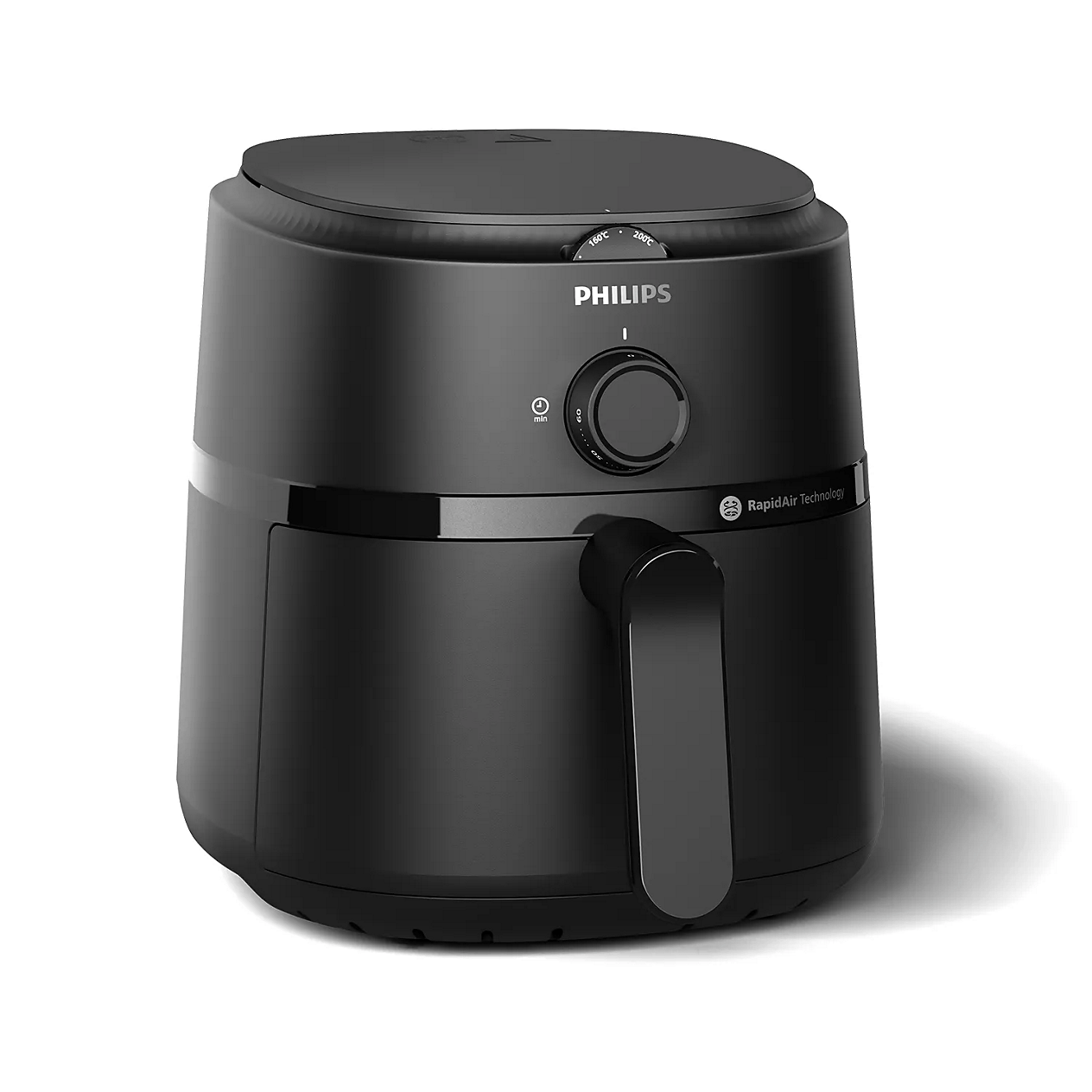
Explore this need in the finder →The Philips 1000 Series NA110/00R0 is a discontinued, small single-basket air fryer documented on Philips's U.S.-hosted product and support pages. Its exact technical record lists a 3.2-liter basket, analog controls, 1,300 watts and a 220–240-volt supply. That last detail matters more than the page address: this is a reference for identifying the /00R0 code, not a U.S. household purchase recommendation.
A compact layout with one shared cook
Philips calls the capacity 3.2 L, which converts to about 3.4 U.S. quarts. That is a nominal vessel figure, not a promise that a given load will cook evenly in one layer. The exact product page describes one removable basket and an analog interface, so the appliance is best understood as one small drawer and one local time-and-temperature routine. There is no second zone to set separately and no viewing window to check browning without pulling the drawer out.
For a shopper comparing the model name, pay attention to the full suffix. Philips also lists an NA110/00 on a separate U.S. product page. Although the same family name and capacity class can look interchangeable at a glance, the two exact pages publish different electrical ratings: this /00R0 page gives 220–240 V and 1,300 W; the /00 U.S. page gives 120 V and 1,500 W, while its frequency field is not usable. Those are not details to smooth over as a spelling difference. The R0 entry should not be plugged into an ordinary 120 V U.S. outlet or treated as a domestic version based on a U.S.-hosted website.
Dial control is simple; the mode list is not a preset list
The official specifications call the interface analogue and the Programs field says “No.” Philips's marketing copy nevertheless advertises 12 cooking methods, mentioning air frying, baking, grilling, roasting, reheating, defrosting and dehydrating. Read that as a list of broad uses rather than a bank of named one-touch programs. The manufacturer publishes a maximum temperature of 200°C (392°F), but the page does not provide a minimum setting, precise timer limits or a detailed dehydration range. If a gentle drying temperature or a particular cooking schedule is essential, this source record cannot confirm it.
The published technical table says the appliance has one basket, no internet connection, no remote control and dishwasher-safe cooking parts. It identifies the unit's outer construction as plastic with metal as a secondary material, but it does not describe the food-contact basket substrate. The basket has a nonstick coating; its chemistry and PFAS status are not specified. A dishwasher-safe claim does not answer a coating-material question, and this model does not meet a request for a documented PFAS-free surface.
Operating details are intentionally limited
The exact Philips support page checked for NA110/00R0 marks the model discontinued. Its current documentation area lists U.K. and E.U. declarations of conformity, but no user manual. The NA110/00 U.S. manual is linked from that separate code's support page, not from this /00R0 record; it should not be silently substituted as the exact instructions for this configuration. Philips's R0 specification does identify the removable basket, analog interface and dishwasher-safe claim, but does not settle detailed care steps, food-table amounts, included accessories or required clearance. The page lists baking, grill and two-layer cooking sets as related accessories; these are not established as items in the box.
The technical table lists 352 × 257 × 273 mm, 2.85 kg and a 0.8 m cord. It also lists a two-year warranty, but does not explain whether that service term applies to a U.S. owner of a unit whose supply rating is 220–240 V. These facts may help identify the appliance; they do not change its electrical fit or fill the missing manual.
Who should use this reference?
It is useful if you are checking an existing Philips label, distinguishing an NA110/00R0 from the U.S.-listed NA110/00, or reading a product record for a supply that matches the printed rating. It is not the choice for a shopper who needs a documented 120 V / 60 Hz appliance. In the reviewed library, the COSORI Lite Mini offers a smaller domestic single-basket alternative with a documented 120 V / 60 Hz rating; COSORI's 6-quart TurboBlaze KUS is a larger domestic option with the same documented supply. Each has its own capacity, controls and care tradeoffs. Even Philips's separate U.S. NA110/00 listing is not treated as confirmed 120 V / 60 Hz, because its own frequency record is incomplete.
The practical conclusion is narrow but important: the NA110/00R0 appears to be an analog, one-basket 3.2 L fryer, yet its exact Philips electrical table places it on 220–240 V mains. Keep it in the model-reference library, not a U.S. shortlist. For an actual purchase, match the full model code and the appliance's own rating label to the outlet and the complete instructions for that exact unit.
Key details at a glance
| Pull-out basket units | 1 |
|---|---|
| Maximum independent cooking zones | 1 |
| Combined nominal capacity | 3.4 qt |
| Connected app controls | No |
| Highest documented setting | 392°F |
| Cooking functions | Philips's exact page lists broad methods including reheating, defrosting and dehydrating, but does not publish the full 12-method table, a named preset list, or a low-temperature range. A low-temperature dehydration match remains unknown. |
| Basket and crisper-plate material | The exact product page lists a nonstick coating and gives plastic/metal for appliance materials; it does not identify the basket substrate, coating chemistry or PFAS status. |
| See-through cooking window | No |
| Dishwasher-safe pan or basket | Yes |
| Listed power | 1300 W |
| Listed supply | 220–240 V / 50–60 Hz |
Use the exact model’s instructions for operating limits, supplied equipment and version differences.
Sources for this assessment
Read the exact model before choosing a cooking routine.
Separate basket layout, actual controls and cleanup claims from the name on the box.