
On this page
Your needs, this model
Does it fit your priorities?
Would one windowed basket and a shared schedule meet the cooking layout you want?
Philips lists one 6.2 L windowed basket. It has one local time-and-temperature schedule; the window is for checking, not a second zone.
Explore this need in the finder →Must both 120 V and 60 Hz be published for the exact code?
The exact NA231/00 specification instead lists 220–240 V / 50–60 Hz, so it cannot meet an essential documentation requirement for 120 V.
Explore this need in the finder →Do you require connected progress and phone setting changes?
No connected-control capability is listed for NA231/00. Kitchen+ recipe access does not establish remote adjustment or cooking start.
Explore this need in the finder →Do you need a precise lower temperature limit or PFAS-free documentation?
The reviewed exact page lists a 200 °C maximum but not a minimum, and the nonstick coating chemistry is unspecified. Neither unknown meets an essential setting or disclosure requirement.
Explore this need in the finder →The Philips 2000 Series NA231/00 is a silver-accented, windowed 6.2 L air fryer with one pull-out basket and digital controls. The first question for an American household is electrical, not capacity: Philips's exact specification lists 220–240 V and 50–60 Hz. That is not the usual U.S. 120 V household supply. This review is therefore an exact-code reference for identification and comparison, not a recommendation to buy this regional configuration for a standard U.S. kitchen.
Keep the suffix attached to the product
Philips uses several closely named NA230 and NA231 codes. This assessment is about NA231/00, not the black NA230/00, NA230/00R0, or silver NA231/00R0. The exact page calls the finish silver; its image shows a mostly black appliance with a bright silver-colored handle and trim. Those are more useful identification clues than the large 2000 Series label. Do not assume a different suffix has the same voltage, frequency, program count, finish, or manual coverage.
Philips's technical row for this exact model records 220–240 V / 50–60 Hz and 1,700 W. Its U.S.-hosted product page does not turn those figures into a domestic 120 V appliance. A plug adapter does not transform voltage. If a unit is already owned, read the nameplate and use a supply that matches it; for a U.S. shopping decision, move to a different exact configuration with its own documentation.
One drawer serves one schedule
NA231/00 has a single removable, windowed basket and digital local controls. It offers a way to inspect food through the front window without opening the drawer just to look, but everything inside still shares a single time-and-temperature cook. The window is not a second zone, and the fryer cannot independently finish a fish fillet while a batch of vegetables follows another schedule. The manual's food table recommends shaking, turning, or stirring some larger loads, so visibility does not remove those steps.
Philips lists a 6.2 L pan and gives manufacturer examples of up to 800 g of fries, eight drumsticks, or 800 g vegetables. These are meal-planning reference amounts, not test results, guaranteed one-layer capacity, or a promise that all foods cook at once. The point of a single drawer is a straightforward shared cook. If you often need two foods at different temperatures, look for separate operating zones rather than treating the window or preset count as a substitute.
Nine programs in the table, thirteen methods in the copy
The exact technical table says nine programs. Philips's descriptive copy separately advertises thirteen cooking methods and names nine touchscreen presets, including frozen and fresh fries, chicken drumsticks, meat, fish, breakfast, vegetables, cake, and keep warm. The separate labels should not be collapsed into a single claim that thirteen automatic presets are present. The official NA230/NA231 family manual also presents nine named menu choices and a fixed Keep Warm setting of 80 °C for 30 minutes. That guide is useful for the base family, but its cover names NA230 and NA231 without suffixes, and the exact NA231/00 support page lists declarations rather than a model-specific manual. Treat detailed menu mapping as family guidance, not a promise about every exact regional revision.
Philips advertises Air Fry, Bake, Grill, Roast, Defrost, Dehydrate, Reheat, and other methods. Those are different jobs on the same basket, not extra cooking cavities. The table lists a maximum of 200 °C (392 °F), but the reviewed exact specifications do not publish a minimum temperature or full timer range. If a precise low setting or long dehydrating run is essential, the broad Dehydrate label is not enough documentation to choose it.
Materials and daily care
The technical table lists plastic and metal as the appliance materials, calls the pan nonstick, and marks removable parts dishwasher-safe. Philips does not identify the food-contact coating chemistry, the basket substrate, or a PFAS-free claim for this exact code. The available NA230/NA231 family guide recommends letting parts cool before cleaning, permits dishwasher washing for the pan and insert, and warns against metal utensils or abrasive tools on the nonstick surface. It also specifies open space around and above the appliance. Because the exact /00 support page does not list that family guide as a manual download, use the instructions supplied with the actual unit if they differ.
The exact specification lists accessories separately and does not confirm a package bundle beyond the base appliance. Treat baking, grill, and breakfast pieces as separate equipment unless the exact seller carton says otherwise. Product marketing also references the Kitchen+ recipe app, but this is a not-connected model: recipe access does not establish app progress monitoring, remote setting changes, or phone start.
Who should compare something else?
For someone who already has NA231/00, the 6.2 L single drawer, window, digital panel, and manufacturer batch suggestions explain the appliance's intended routine. For a normal U.S. purchase, the electrical rating is decisive; do not accept it as a substitute for a model documented at 120 V / 60 Hz. A shopper who wants a similar windowed, one-basket arrangement can compare the Philips NA220/NA221 U.S.-listed family, while recognizing that its nominal capacity is smaller and its exact unsuffixed-code frequency documentation must be checked. If documented domestic voltage and frequency matter more than a window, the HD9867/16 review covers a different XXL configuration with an exact 120 V / 60 Hz table; it is larger and has its own unresolved capacity and warranty conflicts. These are tradeoffs, not lab rankings.
Finally, the regional product page does not establish the exact NA231/00 recall status, seller availability, or warranty applicability to a particular imported unit. No price, performance result, ownership claim, or retailer identifier is inferred here. For any real appliance, verify its complete code, nameplate, supplied manual, and service terms instead of relying on a near-match.
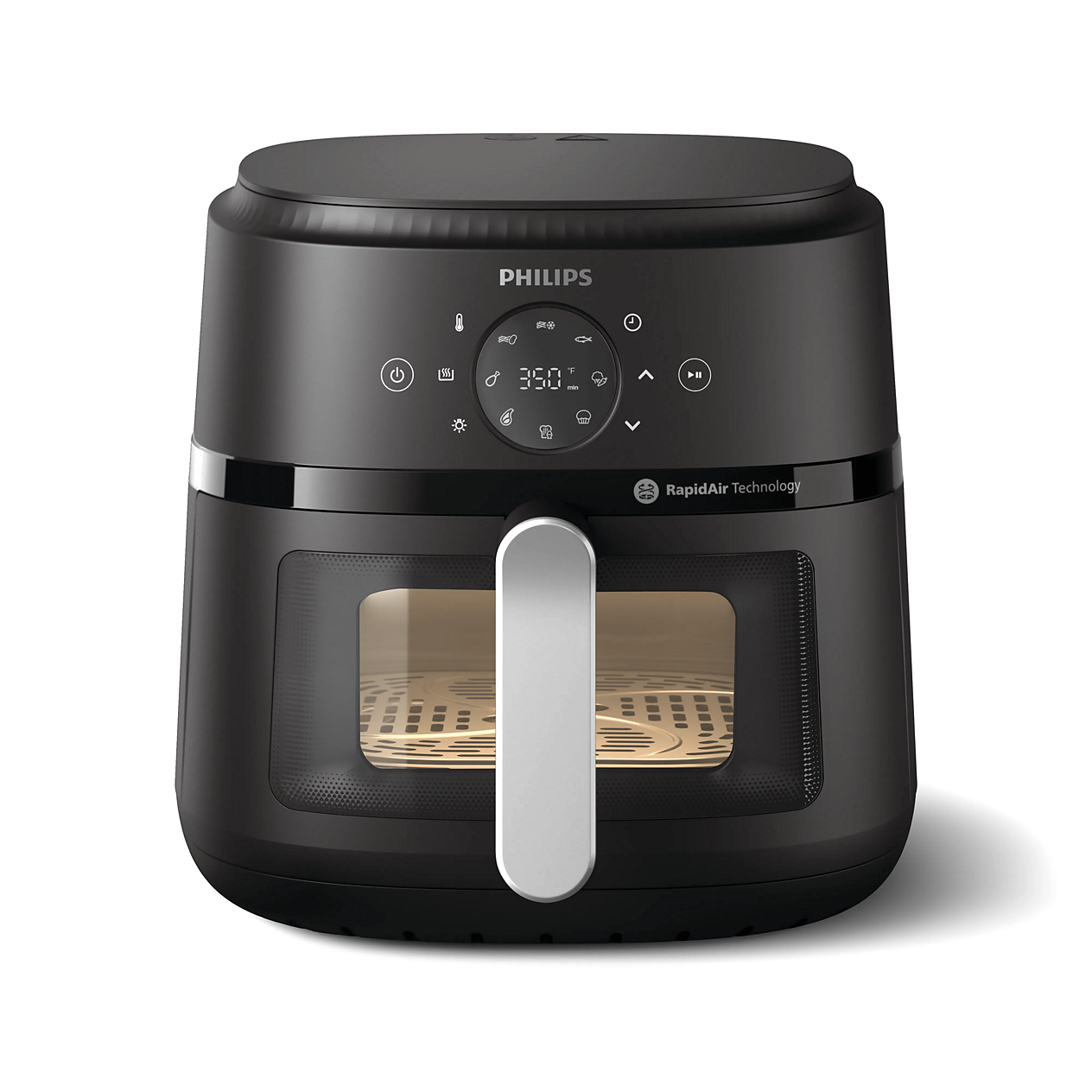
Image source and model notes
Key details at a glance
| Pull-out basket units | 1 |
|---|---|
| Maximum independent cooking zones | 1 |
| Connected app controls | No |
| Highest documented setting | 392°F |
| Cooking functions | Philips's exact NA231/00 product copy describes these 13 methods. Its technical Programs field says nine and its presets are a different count/category. |
| Basket and crisper-plate material | Philips says the cooking parts have a nonstick coating but does not identify its chemistry, the basket substrate, or a PFAS-free claim. |
More specifications and setup details
| See-through cooking window | Yes |
|---|---|
| Dishwasher-safe pan or basket | Yes |
| Listed power | 1700 W |
| Listed supply | 220–240 V; 50–60 Hz |
Use the exact model’s instructions for operating limits, supplied equipment and version differences.
Sources for this assessment
Read the exact model before choosing a cooking routine.
Separate basket layout, actual controls and cleanup claims from the name on the box.