
On this page
Your needs, this model
Does it fit your priorities?
Would you rather split a meal between two unequal baskets than cook in one wide tray?
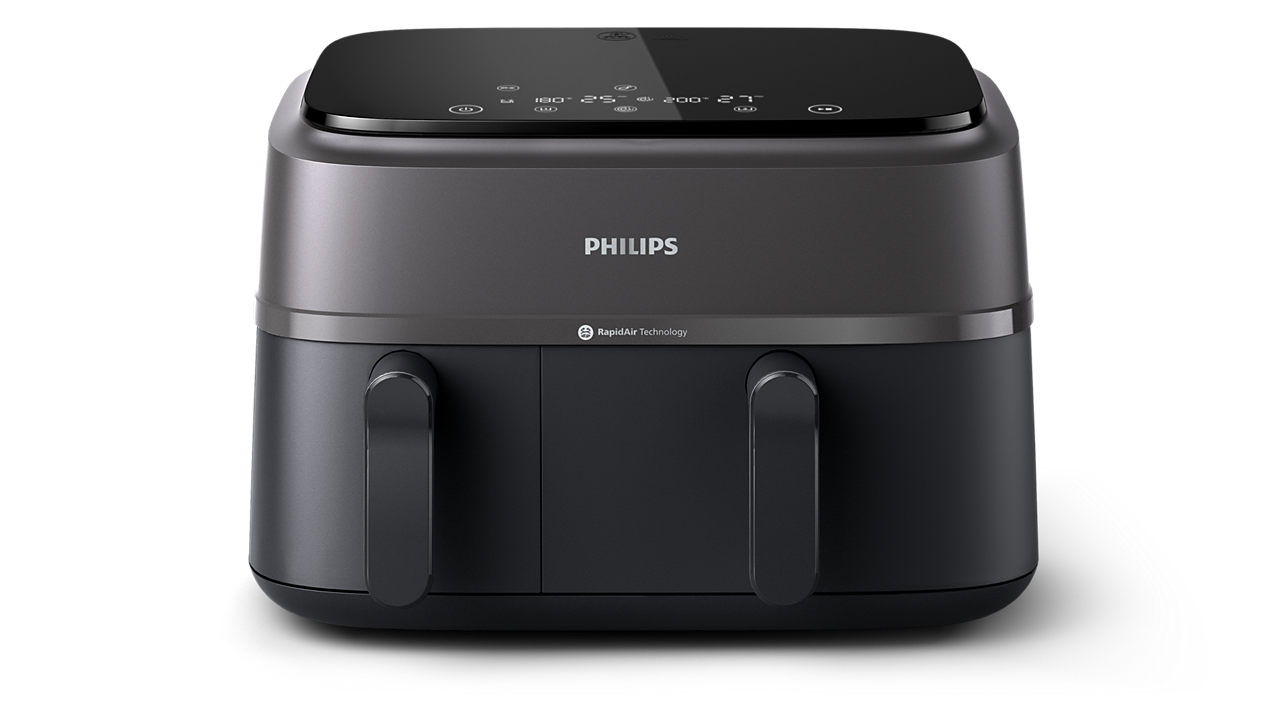
NA350/00 uses a larger and a smaller removable drawer; Philips lists 9 L combined, not 9 L per pan or one continuous basket.
Explore this need in the finder →Do two foods with different settings need to finish together?
The exact NA350/00 material describes a finish-time function; the linked family manual distinguishes this from the separate copy-settings button.
Explore this need in the finder →Must both the voltage and frequency be documented for a U.S. 120 V / 60 Hz outlet?
No. The exact NA350/00 leaflet lists 220–240 V / 50 Hz; this regional configuration fails that essential domestic requirement.
Explore this need in the finder →Do you need a low-temperature setting no higher than 100°F?
No. The exact leaflet gives a 40°C / about 104°F lower setting, above a 100°F limit.
Explore this need in the finder →Do dishwasher-safe pans need to be paired with an explicit PFAS-free cooking-surface statement?
The linked manual permits dishwasher care for the pan and frying insert, but the exact product materials reviewed call the surface nonstick without naming its chemistry or stating PFAS-free.
Explore this need in the finder →The Philips 3000 Series Dual Basket Airfryer NA350/00 is best understood as a regional model whose cooking layout may be useful to study, but whose listed electricity supply does not suit an ordinary U.S. outlet. Philips’s exact leaflet gives 220–240 V, 50 Hz and 2,750 W. A Philips page hosted on a U.S. domain does not override those numbers. Keep this assessment as a reference for identifying the /00 code or for understanding how its two drawers are meant to work; do not treat it as a 120 V / 60 Hz domestic purchase.
Two drawers that do different jobs
Philips describes a larger drawer for a main dish and a smaller one for sides, vegetables or snacks. The official capacity is 9 L in total, roughly 9.5 U.S. quarts by unit conversion; it is not 9 L in each drawer. The brochure says a single large basket can take up to 1.5 kg of Brussels sprouts or a 1.5 kg chicken, but it does not give the two drawers’ individual volumes or a flat cooking footprint. That distinction matters if you usually cook a wide layer of fries or wings: a combined-volume figure cannot tell you whether a particular tray or food arrangement will fit across either smaller drawer.
The separation is the point. Each drawer has its own time and temperature settings, so a user can cook two foods at once without forcing them into the same schedule. Philips documents a finish-time function that coordinates dishes with different settings and a separate copy function for applying matching settings to both sides. The exact user manual’s control diagram and instructions treat those as two different buttons. If you want a large single cavity rather than two unequal pans, this is the wrong form even if the headline capacity seems comparable.
Preset and manual control trade-offs
The exact model brochure lists eight touchscreen presets: fresh and frozen fries, chicken, meat, vegetables, fish, cake and reheat. The family manual provides separate large-pan and small-pan tables, so do not assume a preset’s minutes or suggested food amount are the same for both drawers. Those are starting points from Philips, not independently tested results. The brochure lists an adjustable range of 40–200 °C (about 104–392 °F) and a timer up to 60 minutes. Someone who needs a documented setting below 104 °F should look elsewhere; the low setting is not suitable for every warming or dehydration requirement.
The linked manual names the NA350/00 code among the covered versions and describes how to select one pan or the other, copy settings, synchronize finish times and enable a shaking reminder. It says preheating is not necessary. It also recommends leaving about 10 cm of space behind, beside and above the appliance, and warns that the dual-chamber fryer draws substantial power: avoid running another powerful appliance on the same circuit at the same time. These practical details are more useful than counting the presets alone.
Care and variant details
Philips lists dishwasher-safe baskets on its exact model sheet. The linked family manual further says the pan and frying insert can be cleaned in a dishwasher or by hand with a non-abrasive sponge; let hot parts cool first, remove grease after cooking, and avoid metal utensils or abrasive tools that can damage the coating. Philips identifies the cooking surface as nonstick, but does not state its chemistry or make an explicit PFAS-free claim for NA350/00. A separate “BPA-free inner coating” line in the brochure is not evidence of a PFAS-free cooking surface.
The manual also separates package configurations. It associates a breakfast kit with NA350/03 and NA350/08, while a double-layer insert and skewers belong to specified NA352 and NA353 codes. Those are not reasons to assume an accessory is included with NA350/00. The product code on the appliance and the package contents matter. The brochure lists a 0.8 m cord, 7.85 kg appliance weight and dimensions of 382.5 × 443.9 × 314.2 mm (W × H × D), so measure the intended counter and allow for the manufacturer’s clearance advice.
Who should use this assessment?
NA350/00 is relevant if you are checking a unit already in your home, comparing the Philips unequal-drawer layout, or deciding whether two baskets with coordinated timing suit your meal routine. The product page’s NutriU mention is about recipes tailored to the appliance; the materials reviewed here do not establish phone-based control or remote start. Choose connected controls only when those actions are specifically documented for the exact model.
For a U.S. buyer, voltage is the deciding limitation before basket count, dishwasher care or capacity. The exact leaflet specifies 220–240 V / 50 Hz, so this model fails an essential requirement for documented 120 V / 60 Hz. Compare a separately documented domestic dual-basket model such as the COSORI Dual Basket CAF-R901-AUS instead, and check its own manual and countertop footprint. Do not merge NA350/00 with the separately recorded NA350/00R0 just because both are Philips dual-basket designs: their product suffixes and manufacturer support records identify distinct exact configurations.
Key details at a glance
| Pull-out basket units | 2 |
|---|---|
| Maximum independent cooking zones | 2 |
| Combined nominal capacity | 9.5 qt |
| Lowest documented setting | 104°F |
| Highest documented setting | 392°F |
| Basket and crisper-plate material | Philips specifies a nonstick cooking surface and separately claims BPA-free inner coating in its leaflet; it does not identify the exact cooking-surface chemistry or state that it is PFAS-free. |
More specifications and setup details
| Dishwasher-safe pan or basket | Yes |
|---|---|
| Listed power | 2750 W |
| Listed supply | 220–240 V; 50 Hz |
Use the exact model’s instructions for operating limits, supplied equipment and version differences.
Sources for this assessment
- Philips U.S.-hosted latest Airfryer directory, page 4
- Philips 3000 Series Dual Basket Airfryer NA350/00 exact product page
- Philips support page for exact NA350/00
- Philips Dual Basket Airfryer NA350/00 product leaflet (English, UK release)
- Philips / Versuni NA350–NA353 user manual (US document linked from exact NA350/00 support)
- Philips exact NA350/00 product-page gallery image, front view
- Philips U.S. all-products air-fryer directory, page 7 row 75
Read the exact model before choosing a cooking routine.
Separate basket layout, actual controls and cleanup claims from the name on the box.