
On this page
Your needs, this model
Does it fit your priorities?
Do you want two physical pans with different food roles rather than one wide basket?
NA350/00R0 has separate large and small drawers and a 9 L combined total. It is a split layout, not a single continuous 9 L cavity.
Explore this need in the finder →Should foods with different times be able to finish together?
Philips states that cooking times can synchronize across its two drawers; the linked NA35x manual also distinguishes synchronized finish from copying the same settings.
Explore this need in the finder →Must your exact fryer be documented for a U.S. 120 V / 60 Hz outlet?
The exact NA350/00R0 product page lists 220–240 V / 50 Hz. It does not satisfy that domestic electrical requirement.
Explore this need in the finder →Can dishwasher-safe parts make up for unknown surface chemistry?
The linked manual allows dishwasher cleaning of the pan and basket, but Philips does not identify coating chemistry or explicitly say PFAS-free. An essential electrical or material condition still has to be met.
Explore this need in the finder →The Philips 3000 Series Dual Basket Airfryer NA350/00R0 is a regional two-drawer reference, not an ordinary U.S. countertop recommendation. Philips lists a combined 9 L (about 9.5 qt), two separately controlled baskets, synchronized finish, 2,750 W and a 220–240 V / 50 Hz supply. That supply is the decisive fact for a U.S. household: a Philips-hosted U.S. page does not make this exact configuration a 120 V appliance. Use this review to identify the code, understand the two-pan arrangement, or assess an appliance already in hand—not to infer that it can be plugged into a standard U.S. outlet.
It is a main-and-side layout, not one large pan
Philips describes a larger drawer for mains and a smaller one for sides, vegetables or snacks. The stated 9-liter capacity is shared across the two unequal cooking chambers; it is not 9 liters in each drawer or one uninterrupted basket. The individual chamber volumes and their usable flat-food footprints are not published on the exact page reviewed. If your usual task is a single broad layer of fries, wings or vegetables, two smaller pans may be less convenient than a single basket even when the combined nominal volume looks generous.
The practical advantage is separation. You can put food with different timing in the two drawers, rather than mixing it in one load. The exact product page says the cooking times can be synchronized so the drawers finish together. Its linked NA35x manual describes setting each pan separately, copying the first pan’s time and temperature when both foods need matching settings, and using the time function to coordinate different cooks. These are distinct routines: copy settings is for the same settings; synchronized finish is for different settings that should end together.
The linked family manual adds useful operating boundaries
The exact NA350/00R0 support capture associates the 2025 NA35x user manual with the product code in its document data; the first visible document list shows a quick-start guide and a Show more control. The manual cover names NA350, NA351, NA352 and NA353 without printing the /00R0 suffix. I treat its instructions as linked family guidance, not as a statement that every regional package is identical. It describes eight presets and separate tables for the large and small pan; for example, its fresh-fries preset uses different listed quantities in the two pans. Those tables are starting suggestions, not measured promises for every food or load.
The manual says preheating is unnecessary, calls for leaving about 10 cm of clearance at the back, sides and above, and warns that both pans and baskets become hot. It recommends checking food and shaking or turning when the food table calls for it. It also says not to fill the appliance with oil and not to operate it through an external timer or separate remote-control system. A companion recipe app may help find settings, but this is not a substitute for documented phone-based control of the appliance.
Capacity and accessories need a closer read
The two baskets are sized for different roles, so total capacity alone cannot tell you whether both sides fit your usual meal. The manufacturer’s family tables distinguish the large- and small-pan amounts; the small basket has materially lower food limits in those examples. The manual’s breakfast kit is listed only for NA350/03 and NA350/08. Its double-layer rack and skewers are listed for specified NA352 and NA353 codes. Do not assume those accessories come with NA350/00R0 just because the family manual describes them.
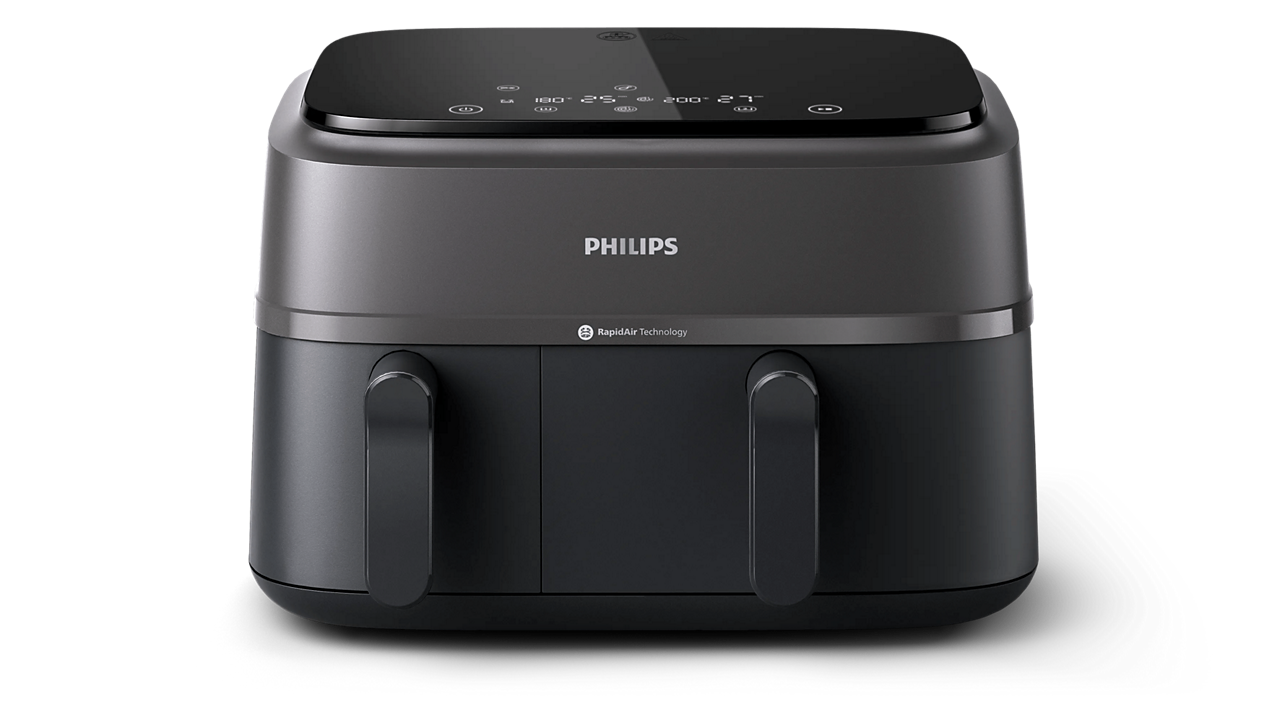
For cleanup, Philips marks the removable pan and basket dishwasher-safe and describes a nonstick coating. The manual says to let the parts cool, remove grease after cooking, and avoid metal utensils or abrasive cleaners that can damage the coating. Philips does not identify the coating chemistry or state that the food-contact surface is PFAS-free; those remain unknown rather than affirmative or negative material claims. The exact product image shows the two separate drawer fronts, but Philips does not disclose whether its isolated gallery image is photography or a rendered product image.
Check the nameplate before treating it as a U.S. purchase
Philips’s exact model page gives 220–240 V / 50 Hz and 2,750 W. The NA350/00R0 support page links a regional family manual that says to compare the appliance voltage with local mains and notes the dual-basket appliance’s high electrical demand. It lists dimensions of about 444 × 383 × 314 mm and weight of 7.85 kg, so check the footprint and clearance before reserving counter space. These details may help an owner identify or plan around the appliance, but the listed supply does not match the usual 120 V / 60 Hz U.S. outlet. Do not try to solve that mismatch by assuming an adapter is enough.
Who should compare it?
NA350/00R0 is most useful to someone checking the exact model code on an existing unit, comparing a regional Philips dual-drawer design, or learning how two independent pans alter meal timing. In a model finder, choosing two physical baskets and a synchronized finish describes its layout; adding a requirement for documented U.S. 120 V / 60 Hz correctly removes it. Dishwasher-safe parts do not override that electrical limit, and unknown coating chemistry cannot satisfy a request for an explicit PFAS-free statement.
For a new U.S. two-basket purchase, compare the COSORI Dual Basket CAF-R901-AUS review: it is a separately documented U.S. configuration with two removable baskets and its own electrical and manual evidence. If you need one wide cooking surface rather than two pans, look at a single-basket model instead. Do not treat the Philips NA350/00R0, NA350/03 or NA350/08 as interchangeable: their manuals distinguish package accessories, and the suffix records different exact configurations.
Key details at a glance
| Pull-out basket units | 2 |
|---|---|
| Maximum independent cooking zones | 2 |
| Combined nominal capacity | 9.5 qt |
| Connected app controls | No |
| Highest documented setting | 392°F |
| Basket and crisper-plate material | Philips identifies a nonstick cooking surface but does not identify the chemistry or make an explicit PFAS-free claim for this exact configuration. |
More specifications and setup details
| Dishwasher-safe pan or basket | Yes |
|---|---|
| Listed power | 2750 W |
| Listed supply | 220–240 V; 50 Hz |
Use the exact model’s instructions for operating limits, supplied equipment and version differences.
Sources for this assessment
Read the exact model before choosing a cooking routine.
Separate basket layout, actual controls and cleanup claims from the name on the box.