
On this page
Your needs, this model
Does it fit your priorities?
Are one pull-out basket and analogue controls enough, or are two cooking zones essential?
Philips documents one 800 g basket with analogue time/temperature control. It has one schedule; the two-drawer/two-zone requirement excludes it.
Explore this need in the finder →Must the exact appliance documents state both 120 V and 60 Hz?
The exact Philips sheet lists 110 V / 50–60 Hz. It does not document 120 V, so a strict both-values requirement fails; check the physical rating label on an existing unit.
Explore this need in the finder →Is a manufacturer-listed quart minimum or explicit PFAS-free disclosure essential?
Philips gives an 800 g food-weight capacity, not quart volume; coating is described as nonstick without a PFAS-free statement. Unknowns do not satisfy either hard filter.
Explore this need in the finder →The Philips Viva Collection HD9220/86 is an earlier, discontinued one-basket air fryer worth keeping in a comparison only if you are identifying or evaluating an existing unit. Philips' exact U.S. page confirms the /86 suffix, marks it discontinued, and describes an 800-gram basket with manual time and temperature control. The page and its exact specification source disagree on the finish, and Philips lists 110 volts rather than the requested 120 volts. That makes this a useful historical model profile, not a current buying recommendation or a plug-compatibility guess.
What the exact /86 offers
This is a small, single-drawer design with local analogue controls rather than a display or app. Philips lists air frying, baking, roasting, and grilling, a timer up to 30 minutes, and a temperature control reaching 390°F. Its exact technical record gives an 800 g capacity, 1,425 W, and 110 V / 50–60 Hz. A weight figure tells you something about a food load, not the nominal quart volume or cooking surface: it should not be converted into a quart rating or treated as a guaranteed serving count.
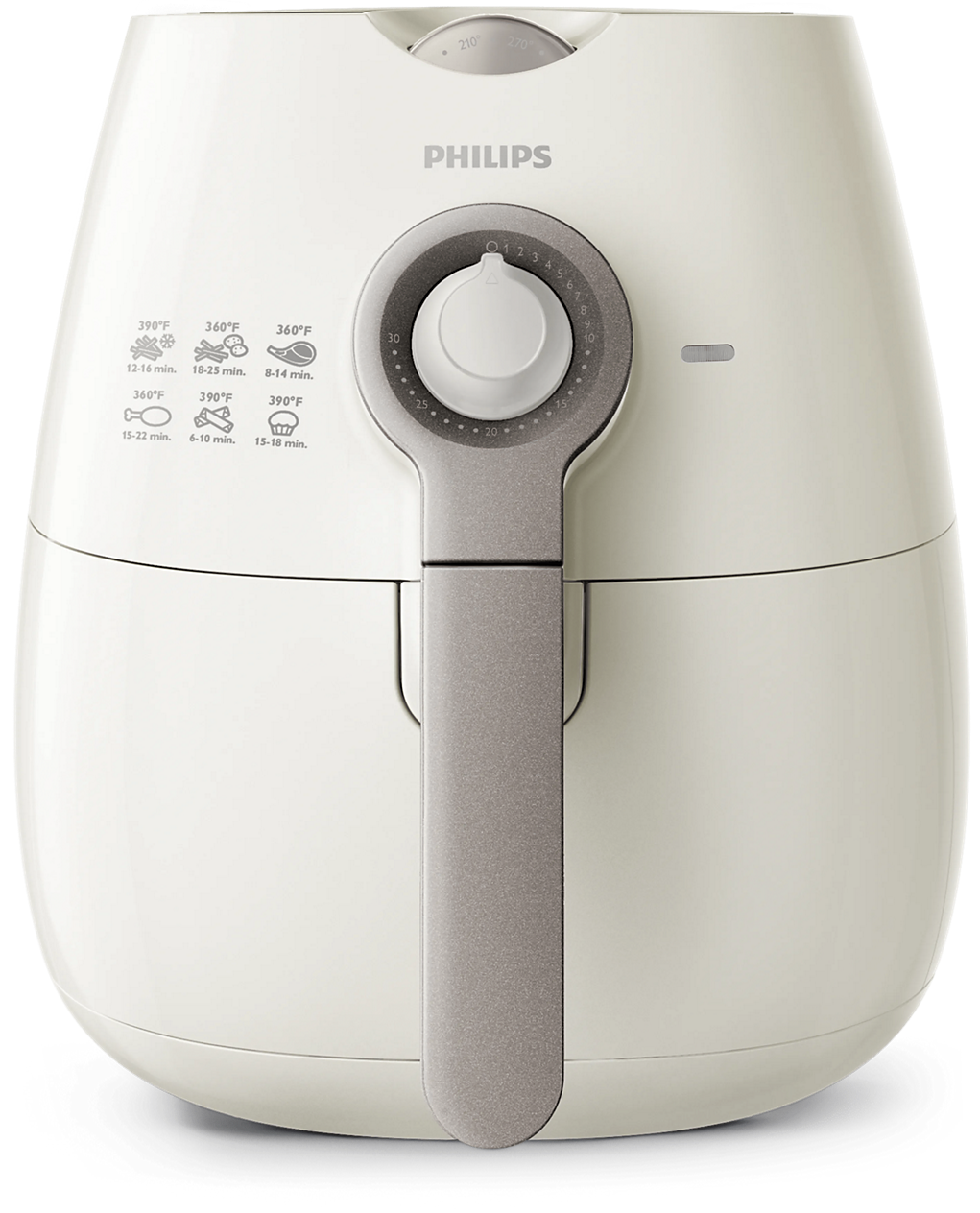
Philips' product page identifies the appliance as black, but the exact manufacturer gallery image looks like a light cream or white housing with a muted gray central control area. The exact product technical sheet also gives a white finish. Those materials conflict, so the full model code matters more than color when comparing a used listing. The gallery image is a real Philips association for this /86 page, but Philips does not explicitly say whether the isolated studio image is a photograph or a render.
The working routine is deliberately simple
The family instruction manual linked from the exact /86 support page shows two manual controls: one thermostat and one timer/power knob. That arrangement is easy to understand without browsing presets, but it leaves one cooking schedule for the one basket. If you need different temperatures for vegetables and chicken, cook in sequence rather than assuming the basket can be split into independent programs. The 30-minute limit also means a longer recipe needs a manually restarted cycle, with an attentive check rather than a continuous long timer.
The manual describes the removable pan and basket, shows the basket lifting out for serving, and explains that the appliance can start cold with an added three minutes or be run empty first if you prefer preheating. It also tells users to shake certain foods during cooking and respect the MAX mark. These are ordinary ownership decisions, not measured performance results. A drawer that must be pulled out for checking also means this isn't a windowed model; there is no claim that it can cook without a manual look or shake.
Capacity, power, and used-unit checks
At 800 g, Philips' capacity description is comparatively clear for an older product, but it still isn't a promise that every dense or piled batch will cook evenly. The manual's food-specific quantities and shaking instructions are more useful than treating the nominal load as a target for all recipes. If a minimum quart size, exact footprint, cord length, or serving capacity is a hard requirement, this model doesn't satisfy it from a manufacturer-listed quart figure: none is published for /86 in the material reviewed.
Electrical records need the same care. Philips' exact /86 specification says 110 V / 50–60 Hz and 1,425 W. It does not say 120 V, so a strict requirement for documents to state both 120 V and 60 Hz should reject it. The actual appliance's own rating plate is the right reference for any used unit; don't infer safe outlet compatibility from its U.S. web page or from another HD9220 suffix. It is also discontinued, so current parts availability, actual unit condition, warranty coverage, and seller package contents are not established here.
Cleaning and limits
The family manual describes nonstick pan and basket surfaces and says those removable components may be washed in a dishwasher. It cautions against metal tools and abrasive cleaning on the coating. Philips does not identify the exact coating chemistry or say that the food-contact surface is PFAS-free. If an explicit PFAS-free claim is non-negotiable, this is not a pass; unknown disclosure is not evidence either way. Inspect the real pan and basket for wear before relying on any second-hand appliance.
Temperature control reaches 390°F, but the low end is not a useful reason to choose this design: the linked manual family range starts at 180°F, so requests for a very low holding or drying setting should be screened separately. The exact web page advertises traditional functions, but no dedicated Dehydrate mode is documented. There is no second basket, independently controlled zone, sync finish, smart control, or window in the examined exact configuration.
How it compares
Choose the earlier-model option in the questionnaire only when you are deliberately comparing discontinued appliances. A requirement for a single analog basket can fit the /86 plan; selecting two baskets, digital controls, a window, a quart minimum, or documented 120 V / 60 Hz changes the answer and should remove it. A positive match on layout does not erase the unresolved finish or supply requirements.
For a current compact alternative, compare the COSORI Lite Mini CAF-LI211-KUS: it trades the Philips dial layout and historic 800 g claim for a smaller stated quart capacity and digital local control, with its own exact electrical documentation. If you need the analogue style but a documented supply and a larger basket, compare a confirmed domestic current model rather than borrowing ratings from HD9220/36, /56, or /58. Each suffix is its own configuration. The HD9220/86 is most helpful as an identification and operating-instructions reference for an existing appliance; it should not be mistaken for proof of present stock, warranty, or a better cooking result.
Key details at a glance
| Pull-out basket units | 1 |
|---|---|
| Maximum independent cooking zones | 1 |
| Lowest documented setting | 180°F |
| Highest documented setting | 390°F |
| Cooking functions | Philips product-page material describes the traditional cooking functions in the family. No Dehydrate mode is documented in the exact evidence reviewed. |
| See-through cooking window | No |
More specifications and setup details
| Dishwasher-safe pan or basket | Yes |
|---|---|
| Listed power | 1425 W |
| Listed supply | 110 V, 50/60 Hz |
Use the exact model’s instructions for operating limits, supplied equipment and version differences.
Sources for this assessment
- Philips U.S. all-products page 1
- Philips U.S. exact-model product page
- Philips U.S. exact-model support page
- Philips manufacturer manual linked to the exact model or its exact product-page data
- Philips exact-model gallery asset
- Philips exact-model specification sheet; browser source inspected, direct byte archive unavailable
- Philips U.S. all-products page 1 observed row
Read the exact model before choosing a cooking routine.
Separate basket layout, actual controls and cleanup claims from the name on the box.