
Your needs, this model
Does it fit your priorities?
Would a digital oven-form appliance suit you if you do not need a drawer basket?
The index lists a Pro XR oven; the linked manual describes one door-front cavity and an LED touch panel, while its printed code is GLA-1001 rather than GLA-1001XR.
Explore this need in the finder →Do you want a separate low-temperature Dehydrator routine?
The linked Pro XR guide documents Dehydrator at 90–170°F for 2–24 hours; exact suffix capacity remains unknown.
Explore this need in the finder →Are two independently set baskets and synchronized finishing essential?
No: the linked Pro XR guide describes one door-front cavity and a single control set, with no two-zone sync.
Explore this need in the finder →Must the nominal capacity be confirmed for this exact suffix?
The index and manual describe 12 qt, but the linked manual code does not match GLA-1001XR, so this record leaves exact-suffix capacity unknown.
Explore this need in the finder →PowerXL Air Fryer Pro XR (GLA-1001XR) review
The PowerXL manual index lists an Air Fryer Pro XR as model GLA-1001XR and describes it as a 12-quart oven. Its linked owner’s guide is also titled Air Fryer Pro XR, but the cover and specification table print GLA-1001 without the XR suffix. That is a meaningful labeling conflict, not proof that the two codes are interchangeable. This review keeps the index’s exact identity separate from the GLA-1001 model and treats the linked guide as the documented Pro XR family reference. Check the appliance rating plate and the instructions for the particular unit before relying on electrical figures or ordering parts.
An oven cavity rather than a pull-out basket
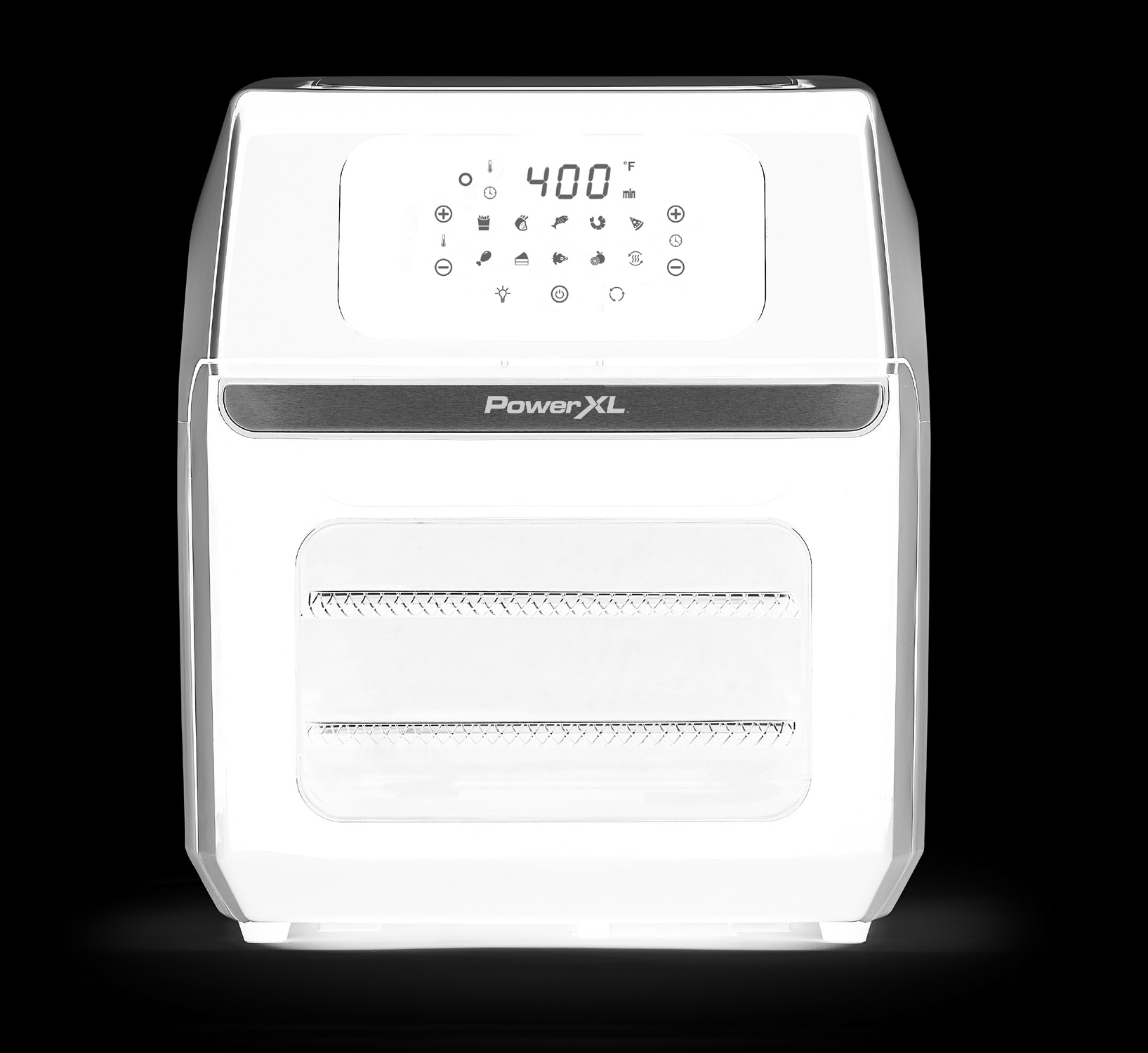
This model makes sense for someone who wants a small countertop oven with air-fry and rotisserie-style uses, not a conventional drawer that comes out as one food basket. The manual describes one door-front cavity, several rack positions and insertable accessories such as crisper trays, a drip tray and a fry basket. It also depicts a lighted glass door, so you can look in and pause to check food without treating the door as a basket window. Multiple shelves provide more than one level, but they do not create independently controlled cooking zones. There is one set of controls, so there is no separate time-and-temperature program or synchronized finish for two different foods.
That layout changes the day-to-day routine. Foods spread across levels may need attention and tray rotation for even browning; the instructions specifically advise rotating the crisper trays mid-cycle. Tall items and rotisserie foods also need enough room to turn freely. This is less convenient than tossing one shallow layer in a drawer, but it offers a different way to arrange food and use accessories. Do not confuse the manual’s “Fry Basket” with a removable drawer basket: it is an insert for the oven cavity, and the manual warns that accessory selection and quantities can vary by offer.
Controls and cooking choices
The guide documents a digital LED touch panel and named presets for Reheat, French Fry, Steaks/Chops, Fish, Shrimp, Pizza, Chicken, Baking, Rotisserie and Dehydrator. Most cooking functions can be adjusted between 150°F and 400°F, with a timer from one to 90 minutes. Dehydrating is a separate low-temperature, long-duration routine: 90°F to 170°F and two to 24 hours in 30-minute steps. Those are useful distinctions if you want to make dried fruit or herbs as well as cook meals; the dehydrator setting does not mean that every other preset can run at the same low temperature for a day.
The presets are starting points rather than cooking results. For example, the manual’s French Fry preset defaults to 400°F for 18 minutes, while Reheat defaults to 240°F for 12 minutes. The guide asks users to preheat and explains that load size, food size and flipping affect timing. Those instructions are more useful than treating a preset count as evidence that the appliance will cook every batch evenly. There are no independent measurements here of temperature accuracy, crispness, noise or cooking speed.
Space, cleanup and package checks
A door-front oven needs counter clearance in front for the door and a heat-resistant place to set a hot tray. The linked guide calls for five inches of clearance from surrounding objects and says to keep the intake and outlet vents unobstructed. It also describes a dedicated 120-volt outlet; because its printed model code does not match the index suffix, verify the rating plate on the actual unit rather than treating that line as a confirmed GLA-1001XR electrical rating. This is an especially important check for a used or imported appliance.
The manual describes stainless-steel accessories as dishwasher-safe, while recommending hand-washing for caked-on food. The appliance body, door and heating area are not dishwasher-safe and must not be immersed. The exact accessory kit is not established by the model name alone: the guide notes that some pieces may be sold separately and quantities vary. Before purchase, make sure the specific listing includes the trays or rotisserie parts you actually want, and check whether replacements are available if those parts are essential.
Who should consider it
Consider the Pro XR if an oven-shaped single cavity, digital controls, several preset routines and a separately adjustable dehydrating program match the way you cook. It is not a fit if you require two removable drawers, independent zones, synchronized finishing or a compact basket footprint. The manual index calls the model 12 quarts, and the linked Pro XR guide also says 12 quarts, but its printed model code is GLA-1001; the capacity is therefore not used here to pass a strict minimum-capacity filter for GLA-1001XR.
There is also no confirmed exact exterior size, coating chemistry, present warranty, current stock status or complete package for this suffix. Those gaps matter more than the number of presets if the appliance must fit a particular counter, meet a specific materials requirement or arrive with a particular accessory. Treat it as an earlier, oven-form model reference, compare the label and supplied parts with the seller’s exact unit, and choose a better-documented configuration if a hard electrical, capacity or accessory requirement cannot be verified.
Key details at a glance
| Pull-out basket units | 0 |
|---|---|
| Maximum independent cooking zones | 1 |
| Lowest documented setting | 90°F |
| Highest documented setting | 400°F |
| Cooking functions | The linked Pro XR guide names Reheat, French Fry, Steaks/Chops, Fish, Shrimp, Pizza, Chicken, Baking, Rotisserie and Dehydrator. It documents ordinary presets from 150–400°F with 1–90-minute timing and a separate Dehydrator range of 90–170°F and 2–24 hours in 30-minute increments. The index-to-manual model-code discrepancy remains explicit. |
| Basket and crisper-plate material | Manual describes accessories as stainless steel but does not state food-contact coating chemistry for the Fry Basket. No PFAS-free claim is made. |
| Exact configuration note | The index lists exact model GLA-1001XR; the linked Pro XR manual prints GLA-1001. Verify the unit label and parts compatibility. |
| See-through cooking window | No |
| Manufacturer-listed oven timer maximum | 90 min |
Use the exact model’s instructions for operating limits, supplied equipment and version differences.
Sources for this assessment
Read the exact model before choosing a cooking routine.
Separate basket layout, actual controls and cleanup claims from the name on the box.