
Your needs, this model
Does it fit your priorities?
Do you want one digital basket with a documented minimum capacity of 7 quarts?
The model table lists the HF-196DT as a one-basket, 7-quart configuration; the family chart lists 28 oz of fries as a food-specific guide, not a universal serving count.
Explore this need in the finder →Do you require a documented U.S. 120 V / 60 Hz supply and 400°F upper setting?
The HF-196DT table gives 120 V / 60 Hz, 1700 W and an 180–400°F adjustment range.
Explore this need in the finder →Is a Dehydrate function essential?
The exact Classic chart lists seven presets for HF-196DT and none is Dehydrate; absence does not satisfy a hard mode requirement.
Explore this need in the finder →Is a Pizza preset essential?
The HF-196DT chart names French Fry, Roast, Bake, Fish, Shrimp, Chicken and Steak; it does not list Pizza.
Explore this need in the finder →Must the outer cooking basket itself be dishwasher-safe?
Manual says only the Fry Tray is dishwasher-safe; hand washing is directed for the outer basket.
Explore this need in the finder →Do you need two separate cooking zones and synchronized finish?
The exact configuration has one basket and one control panel; the manual does not document separate cooking zones or sync finish.
Explore this need in the finder →Must you see through the basket while food cooks?
The model-labelled reference image shows an opaque basket front; no viewing window is documented for this configuration.
Explore this need in the finder →PowerXL’s Classic Air Fryer HF-196DT is the largest configuration in the family manual that also covers the 4-quart HF-509DT and 5-quart HF-8959DT. The model-specific table assigns the HF-196DT a 7-quart basket and 1,700-watt rating on 120 V / 60 Hz power. It remains a single drawer with one cooking area. That distinction matters more than a large capacity label if you want to finish two foods independently: this model gives more room in one batch, not a second zone.
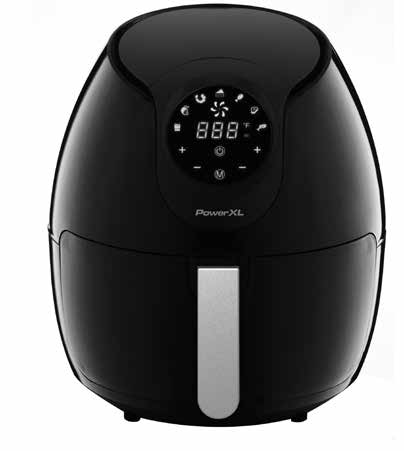
The largest drawer in a three-size family
The manual’s capacity chart gives 16 ounces of French fries for the 4-quart model, 22 ounces for the 5-quart model, and 28 ounces for the HF-196DT. Use those numbers as the maker’s food-specific examples rather than translating quarts or ounces into a guaranteed serving count. Different cuts, moisture, and spacing change how much can cook acceptably together. The instructions tell users to shake some foods halfway through and treat cooking-chart timings as guidelines, not promised results.
Going from five to seven quarts raises the model’s rated power from 1,500 to 1,700 watts while keeping the basic pull-out basket format. The 4-quart version is listed at 1,200 watts and has only four charted presets; the 5- and 7-quart panels share the seven charted presets.
Seven listed presets, manually adjustable temperature
For the HF-196DT, the printed chart names French Fry, Roast, Bake, Fish, Shrimp, Chicken, and Steak. The manual explicitly says Roast, Bake, and Shrimp are for the 5- and 7-quart versions only. The display begins at 370°F and 15 minutes; its time controls run from zero to 60 minutes in one-minute steps, and the temperature range is 180°F to 400°F in ten-degree steps. These are local digital controls, not a connected cooking system. A preset supplies a starting time and temperature; it does not identify the food’s thickness, quantity, or safe internal temperature for you.
Preheating is possible through the ordinary controls rather than a separate named program. The instructions describe setting the temperature and running a three-minute preheat, and the FAQ says to add three minutes when starting from cold. Use the manual’s exact instructions for the model and recipe; there is no basis to treat a preheat cycle as an extra cooking zone. The chart does not list Pizza, Keep Warm, Dehydrate, Grill, or Broil for this configuration. If one of those specific functions is essential, look for a model whose own page or manual names it rather than inferring it from the seven-quart capacity.
One basket means one timing decision
The HF-196DT has one outer basket, a separate fry tray, one interface and one cycle. Pulling the basket out to shake or check food is part of the routine. You can adjust a time or temperature and make another batch, but the documentation does not describe separate controls, synchronized finish, or independent settings for a second cooking zone. Choose basket form and one cooking area in the finder if that arrangement suits you. If the requirement is two baskets, two distinct temperatures, or a synchronized meal, a true dual-zone appliance is a better direction even when its individual baskets are smaller.
Hand-washing the outer basket
The manual describes the basket and fry tray as having a special nonstick surface. It says the fry tray is dishwasher-safe; the outer basket is cleaned with hot water, mild detergent, and a nonabrasive sponge. The manual does not identify the coating chemistry or call the surface PFAS-free. It also does not establish an exact metal basket body or guarantee coating durability. That makes this a poor match for a hard stainless-steel basket or material-chemistry requirement, even though the manual confirms a nonstick cooking surface.
The family parts list includes the main unit, control panel, vents, power cable, fry tray, basket and handle, but warns that package contents vary and some accessories may be sold separately. Do not assume a seller’s image proves a second rack, baking pan, or replacement tray is bundled. Check the exact HF-196DT listing and included-parts statement before treating an accessory as part of the price.
Counter space and earlier-model status
The manual calls for 120 V / 60 Hz power, a dedicated grounded outlet, and at least five inches of clear space at the back, sides, and above during operation. Those requirements are relevant to a 1,700-watt countertop appliance. The manual does not list exterior dimensions or weight, so measure the exact unit and nearby cabinets rather than estimating its footprint from the 7-quart capacity. The source capture of PowerXL’s current air-fryer collection does not list the HF-196DT; that absence cannot establish present stock, discontinuation, or a seller’s package.
When the 7-quart version is the right comparison
Choose HF-196DT when you want the largest of this manual’s three Classic baskets, seven named food presets, a 400°F upper setting, and a single local digital control area, and when hand-washing the outer basket is acceptable. It can meet a 7-quart minimum when you opt into earlier models. It cannot meet an 8-quart minimum, a dual-zone requirement, a documented Dehydrate or Pizza function, or a requirement for a dishwasher-safe outer basket. The smaller HF-509DT and HF-8959DT remain different model configurations, not “the same air fryer” with interchangeable specifications: the 4-quart model has a lower wattage and fewer charted presets; the 5-quart model sits between them on capacity and power.
This is a manual-based assessment, not a report of measured cooking results. Dimensions, weight, current availability, current warranty, exact seller contents, and coating chemistry remain unverified. Confirm the printed HF-196DT code on any offer before buying, and use the manual’s cooking chart as a starting point rather than a guarantee.
Key details at a glance
| Pull-out basket units | 1 |
|---|---|
| Maximum independent cooking zones | 1 |
| Combined nominal capacity | 7 qt |
| Lowest documented setting | 180°F |
| Highest documented setting | 400°F |
| Cooking functions | The model-specific preset chart names French Fry, Roast, Bake, Fish, Shrimp, Chicken and Steak. Reheating is described through manual time/temperature selection; Pizza, Dehydrate, Grill, Broil and Keep Warm are not charted for this model. |
| Basket and crisper-plate material | The owner manual identifies a special nonstick surface but does not identify its chemistry, PFAS status, or basket-body metal. |
| See-through cooking window | No |
| Dishwasher-safe pan or basket | No |
| Listed power | 1700 W |
| Listed supply | 120 V AC, 60 Hz |
Use the exact model’s instructions for operating limits, supplied equipment and version differences.
Sources for this assessment
Read the exact model before choosing a cooking routine.
Separate basket layout, actual controls and cleanup claims from the name on the box.