
On this page
Your needs, this model
Does it fit your priorities?
Would one moderately sized basket and physical dials cover your usual batch?
Philips lists one 4.1 L removable basket, one analogue interface and one cooking zone. Different foods share one temperature-and-time session rather than cooking independently.
Explore this need in the finder →Do you need a window to check browning without removing the drawer?
The exact technical table says there is no transparent lid, and the exact Philips image shows an opaque single drawer. The basket must be pulled out for a direct look.
Explore this need in the finder →Does the machine have to show 120 V and 60 Hz in the exact documentation?
Philips lists 1,400 W but not voltage or frequency for HD9200/91. Its safety booklet tells the user to check the appliance rating plate, so the exact documentation does not meet a mandatory 120 V / 60 Hz disclosure requirement.
Explore this need in the finder →Do you need a documented lower-temperature setting for proofing or drying?
The exact model information names Dehydrate among its 12-in-1 uses, but it does not publish a minimum setting or a detailed dehydration schedule. The feature claim alone cannot meet an essential numeric low-end requirement.
Explore this need in the finder →Is an explicit PFAS-free statement essential for the food-contact surface?
Philips describes a nonstick basket coating without identifying its chemistry or making an exact-model PFAS-free statement. Unknown surface chemistry cannot meet this requirement.
Explore this need in the finder →Would a digital windowed basket be a better choice for checking food?
The Philips NA221/00 is the positive nearby windowed single-basket example. The HD9200/91 is analogue and opaque, so it does not qualify when that visual access is essential.
Explore this need in the finder →Philips’s U.S. page calls HD9200/91 a 3000 Series Airfryer L; its directory and support documents also use Essential Airfryer. The exact appliance is black, has one opaque removable drawer and analogue controls, and lists a 4.1 L pan, 1,400 W, seven presets, a 200°C maximum and a 60-minute timer. Exact-model materials do not give a detailed food-quantity table.
A straightforward one-drawer routine
The HD9200/91 is aimed at someone who wants to turn a temperature dial, turn a timer dial, and cook a modest amount of food in one session. Philips lists seven presets, but the interface is analogue, not a touchscreen. The top and time settings are adjustable, and the timer is paired with automatic shutoff and a ready signal. This is easier to understand than a screen full of menus, but it does not provide the precision of setting an exact digital time or checking the food through a window.
The single removable basket has one cooking area. A batch of fries and a chicken portion therefore share one temperature and timer; food with different schedules has to be staggered or cooked in separate rounds. The quick-start drawings for the Essential family show a basket shake-and-return cycle during cooking. A viewing window is not present on the exact product image, so checking browning means pulling the drawer out and looking directly. If an uninterrupted look-in window or two separately timed zones is important, this is the wrong layout.
Capacity is useful, but still needs batch planning
At 4.1 L, Philips gives a volume figure rather than usable flat area or a promise for crisping dense loads. The exact-model information lacks a detailed quantity-and-time chart, so a household that relies on published portion tables may prefer a fryer with a full manual and clearer load guidance.
The body measures 360 × 264 × 295 mm and weighs 4.5 kg, with a listed 0.8 m cord. That makes it easy to move compared with a countertop oven, although the short lead constrains where it can sit. Philips’s safety booklet asks for open space around the appliance and above it and cautions against blocking its air openings. Leave room for the drawer to slide out and for hot exhaust rather than tucking it tightly beneath cabinets.
Preset count versus cooking flexibility
The exact technical table lists seven presets and an adjustable thermostat up to 200°C (392°F). Philips’s exact-model product sheet groups twelve uses and explicitly names air frying, baking, grilling, roasting, dehydrating, toasting, defrosting and reheating. Those are uses of one basket, not twelve separate mechanisms. The sheet does not give the lowest temperature or a full dehydration schedule, so an exact low-end requirement needs a model whose manual publishes that range.
Philips promotes its Kitchen+ recipe app on the product page, but the exact technical record says the appliance has no internet connection and no remote control. The app is for recipes, not remote monitoring, adjusting or starting a cook. That distinction matters if “smart” features are part of your reason for buying.
Cleaning and material details
The removable pan and basket are described as dishwasher-safe, and Philips calls the basket coating nonstick. The exact coating chemistry and a PFAS-free statement are not supplied, so this model cannot meet a strict requirement for an explicitly disclosed PFAS-free food-contact surface. The product table lists plastic and metal as primary and secondary appliance materials; it does not identify the basket body’s substrate. If those material details are essential, treat them as unknown rather than guessing from the glossy exterior or the product image.
The exact support record links a short visual quick-start guide and a safety-information booklet. It does not provide a detailed exact-model cooking table with food quantities and times. The quick-start guide shows the separate basket and pan and care symbols, while Philips’s product page carries the broad dishwasher claim. This is enough for a simple routine, but a buyer who relies on model-specific cooking tables should prefer a product whose full user manual and portion guidance are clearly available.
When another model makes more sense
The Philips NA221/00 is a nearby single-basket alternative with digital controls and a window. Its 4.2 L listed capacity is similar, so the difference is how you set and monitor a cook, not a large size jump. It has separate electrical and surface-material caveats; do not borrow HD9200/91 specifications or assume a documented 60 Hz rating.
For a larger single basket, the COSORI TurboBlaze CAF-DC601-KUS lists 6 qt and documents a U.S. 120 V / 60 Hz supply. It takes more counter space and uses digital controls, but its larger stated capacity better suits bigger batches. The smaller COSORI Lite Mini is a different capacity tradeoff rather than a like-for-like substitute.
Who should consider the HD9200/91?
This exact Philips suits a shopper who values simple physical controls, a removable one-basket design, and a moderate nominal capacity more than a window, dual-zone timing or connected cooking. Its seven presets are available without app setup, while the analog knobs are also a tradeoff for anyone who wants exact digital adjustments. It is a weaker choice if you need a verified minimum temperature, published exact-model cooking tables, identified nonstick chemistry, or documented 120 V / 60 Hz operation. The Philips U.S. page identifies the model, but its specification record does not state voltage or frequency; check the appliance rating plate before treating it as suitable for a particular outlet. The image below is the official Philips image associated with the exact model page; Philips does not say whether it is a photograph or a rendered image.
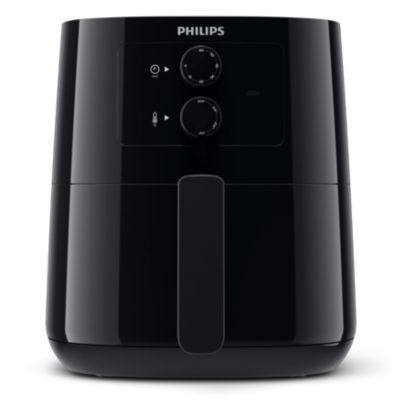
Image source and model notes
Key details at a glance
| Pull-out basket units | 1 |
|---|---|
| Maximum independent cooking zones | 1 |
| Combined nominal capacity | 4.3 qt |
| Connected app controls | No |
| Highest documented setting | 392°F |
| Cooking functions | Philips exact-model product information explicitly names air frying, baking, grilling, roasting, dehydrating, toasting, defrosting and reheating within its 12-in-1 claim. The exact minimum temperature and a detailed Dehydrate schedule remain unpublished; no proof or steam mode is inferred. |
More specifications and setup details
| Basket and crisper-plate material | Philips calls the exact-model basket coating nonstick. It does not identify the food-contact coating chemistry or state PFAS-free for HD9200/91; plastic/metal fields describe the appliance, not the basket base. |
|---|---|
| See-through cooking window | No |
| Dishwasher-safe pan or basket | Yes |
| Listed power | 1400 W |
Use the exact model’s instructions for operating limits, supplied equipment and version differences.
Sources for this assessment
- Philips U.S. latest Airfryer directory, page 2
- Philips U.S. exact HD9200/91 product page
- Philips U.S. exact HD9200/91 technical product page
- Philips U.S. exact HD9200/91 support page
- Philips U.S. alternate support rendering for exact HD9200/91
- Philips exact HD9200/91 product-information PDF linked from alternate support
- Philips Essential Airfryer multilingual Quick Start guide
- Philips Essential Airfryer Important Information safety booklet
- Philips exact HD9200/91 product-page image
- Philips U.S. current recall programs page
- U.S. CPSC Philips manufacturer recall listing
Read the exact model before choosing a cooking routine.
Separate basket layout, actual controls and cleanup claims from the name on the box.