
On this page
Your needs, this model
Does it fit your priorities?
Would a windowed digital basket for one shared cooking session fit your routine?
Philips lists one removable, digital basket and a cooking window. This is a single-basket setup, not a documented dual-zone plan.
Explore this need in the finder →Must an air fryer be documented for U.S. 120 V / 60 Hz mains?
The exact NA331/00R0 technical table specifies 220–240 V / 50 Hz, so it cannot satisfy an essential U.S. 120 V / 60 Hz requirement.
Explore this need in the finder →Must the exact high temperature ceiling be consistent across the product table and linked family manual?
The exact technical table states 200°C (392°F) maximum, while the code-linked NA33X family manual says 400°F. Because the sources disagree, the exact high limit is unresolved.
Explore this need in the finder →Do you require the manual to confirm dishwasher cleaning for the basket or pan?
The exact-code-linked NA33X family manual says to clean the pan and basket in a dishwasher. It does not resolve U.S. electrical compatibility, and the surface chemistry remains unknown.
Explore this need in the finder →Must the exact manufacturer identify a PFAS-free food-contact surface?
The technical table says non-stick but does not name the coating chemistry or state that the exact cooking surface is PFAS-free. Unknown chemistry does not meet that essential disclosure requirement.
Explore this need in the finder →The Philips 3000 Series NA331/00R0 is a windowed, digital air fryer with one removable 6.2 L basket. Its exact technical table lists 220–240 V, 50 Hz and 1,700 W. That regional rating matters more than the Philips U.S.-hosted product address: this /00R0 is a reference model, not a U.S. 120 V / 60 Hz purchase recommendation.
One drawer, one shared cook
The useful layout is a single pull-out basket with a front viewing window. Philips's exact table calls it a single basket, and the product image shows one digital control surface above one drawer. Treat it as one shared air-frying session: it is not documented as having a divider, independent time-and-temperature zones or synchronized finishes. If a main and side need different temperatures, plan separate batches or choose a genuinely dual-zone model instead.
Philips lists 6.2 L. That is nominal volume, not a tested layer of food, family-size promise or measured tray area. A quart figure sometimes attached to a nearby NA331 code is not a reason to blend suffixes. If you are identifying a unit at home, compare the entire model code on its label; similar model names do not make two electrical tables or included parts interchangeable.
Read the feature labels carefully
The page promotes RapidAir Plus, a window and “16 functions”; its technical table lists 12 programs, digital controls, a thermostat, timer and keep warm. An exact-code-linked NAM family manual gives 100–400°F manual mode, but the page’s 200°C maximum differs; the exact ceiling is unresolved. It also does not map 12 programs and 16 functions into one verified button list.
The window may make it easier to look at browning without pulling out the drawer, but it cannot substitute for turning, shaking or other handling a model-specific guide may call for. I have not treated the manufacturer's general circulation claims as a cooking test or a guarantee that every crowded load will brown evenly.
A family manual adds useful limits, with a suffix caveat
The exact product page links a 2026 English NAM manual under NA331_00R0, but its cover says NA32X/NA33X/NA34X, not /00R0. I use its NA33X section as family guidance, not retail-package proof. It says preheating is unnecessary and permits 100°F low settings. Its 24-hour-at-100–215°F and 3-hour-above-215°F timer entries conflict with the same manual’s “60 minutes ON in a two hour period” safety warning; the safe maximum run time is unknown. The manual confirms pan and basket dishwasher care, but not coating chemistry, the accessory bundle or a button map for the product page’s 12/16 counts.
Capacity and accessories do not settle counter fit
Philips lists body dimensions of 436 × 324 × 303 mm (about 17.2 × 12.8 × 11.9 in), a 5.6 kg weight and a 1 m cord with storage. Those figures help with a rough counter check, but they are not a clearance plan; leave the ventilation room required by the exact full manual once you obtain it. The same technical table lists a general two-year warranty, but its regional conditions do not establish what coverage would apply to a U.S. buyer.
Do not assume the grill, breakfast or two-layer cooking sets are in the box. Philips lists those as related accessories and shows the included-accessories field as “N/a”; the names show compatibility/relatedness, not a confirmed retail package. Check an exact local listing and the appliance rating plate before considering any purchase, particularly for a secondhand unit. This review does not establish an exact-code, all-unit recall status or serve as a safety clearance.
Who should compare it—and what changes the choice
The NA331/00R0 is most useful to understand if you already own that precise regional code, need to distinguish it from a close Philips model, or are comparing a single windowed drawer with more flexible layouts. It is not suitable for a U.S. household that needs standard 120 V / 60 Hz mains; its confirmed 220–240 V / 50 Hz rating is a hard mismatch. It also cannot meet a two-zone request. The manual documents the low setting and dishwasher-cleanable pan and basket, but its timer limits conflict with a safety warning and its top temperature conflicts with the product table. Coating chemistry, app behavior and exact recall status remain open.
For documented U.S. supply and a similar six-quart routine, the COSORI TurboBlaze CAF-DC601-KUS lists 120 V / 60 Hz, but has no Philips window. The smaller windowed NA221/00 page lists 120 V but not frequency, so it does not meet an essential 120 V / 60 Hz filter. For two zones, compare the COSORI TWINFRY divider-based plan or a two-drawer model. None shares this code or regional rating.
Philips's official image below is linked from the exact NA331/00R0 product page. It shows one front window, digital controls and a silver-centered drawer handle. The manufacturer does not say whether this isolated studio-style image is a photograph or a product rendering.
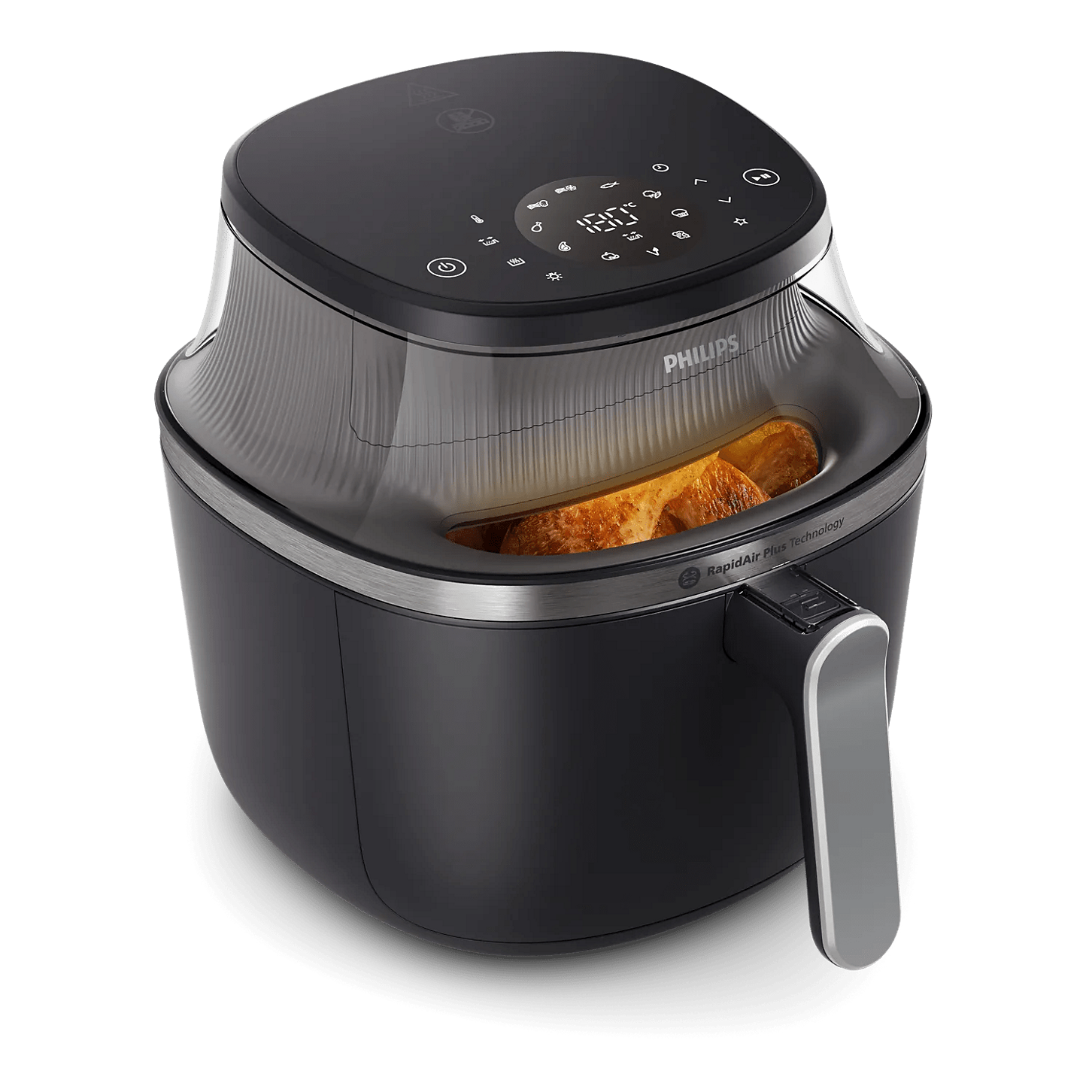
Image source and model notes
Key details at a glance
| Pull-out basket units | 1 |
|---|---|
| Maximum independent cooking zones | 1 |
| Combined nominal capacity | 6.6 qt |
| Connected app controls | No |
| Lowest documented setting | 100°F |
| Cooking functions | Air-frying is the core one-basket use, and the exact technical table lists keep warm. The code-linked NA33X family manual describes favorite setting, shaking reminder, light and keep-warm operation at 175°F for 1–30 minutes. It gives a low setting of 100°F but has conflicting maximum temperature and timer/safety claims; app/connectivity behavior remains unspecified. |
More specifications and setup details
| Basket and crisper-plate material | The technical table says non-stick, and the family manual refers to a non-stick pan; neither identifies the coating chemistry, basket substrate or a PFAS-free statement. |
|---|---|
| See-through cooking window | Yes |
| Dishwasher-safe pan or basket | Yes |
| Listed power | 1700 W |
| Listed supply | 220–240 V / 50 Hz |
Use the exact model’s instructions for operating limits, supplied equipment and version differences.
Sources for this assessment
- Philips U.S. latest Airfryer directory, page 2
- Philips exact NA331/00R0 product page and technical specification payload
- Philips exact NA331/00R0 support page
- Philips / Versuni NA32x, NA33x and NA34x Important Information Manual, English section
- Philips exact NA331/00R0 gallery main image, Single Product Shot
- Philips / Versuni 2026 NA32X, NA33X, NA34X User Manual — English NAM edition
Read the exact model before choosing a cooking routine.
Separate basket layout, actual controls and cleanup claims from the name on the box.